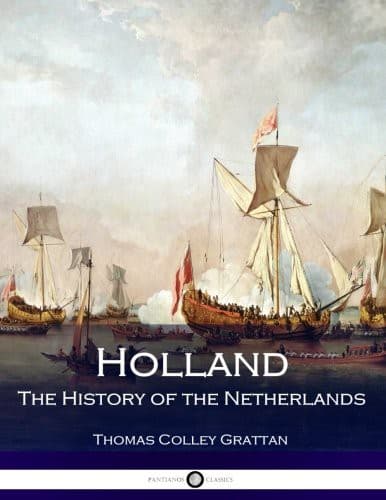
Holland: The History of the NetherlandsGrattan, Thomas Colley
History
Holland: The History of the Netherlands
Grattan, Thomas Colley
Netherlands -- History
There is but one important feature in the character of William
which we have hitherto left untouched, but which the circumstances
of his death seemed to sanctify, and point out for record in the
same page with it. We mean his religious opinions; and we shall
despatch a subject which is, in regard to all men, so delicate,
indeed so sacred, in a few words. He was born a Lutheran. When
he arrived, a boy, at the court of Charles V., he was initiated
into the Catholic creed, in which he was thenceforward brought
up. Afterward, when he could think for himself and choose his
profession of faith, he embraced the doctrine of Calvin. His
whole public conduct seems to prove that he viewed sectarian
principles chiefly in the light of political instruments; and
that, himself a conscientious Christian, in the broad sense of
the term, he was deeply imbued with the spirit of universal
toleration, and considered the various shades of belief as
subservient to the one grand principle of civil and religious
liberty, for which he had long devoted and at length laid down
his life. His assassin was taken alive, and four days afterward
executed with terrible circumstances of cruelty, which he bore
as a martyr might have borne them. He was a native of Burgundy,
and had for some months lingered near his victim, and insinuated
himself into his confidence by a feigned attachment to liberty,
and an apparent zeal for the reformed faith. He was nevertheless
a bigoted Catholic and, by his own confession, he had communicated
his design to, and received encouragement to its execution from,
more than one minister of the sect to which he belonged. But his
avowal criminated a more important accomplice, and one whose
character stands so high in history that it behooves us to examine
thoroughly the truth of the accusation, and the nature of the
collateral proofs by which it is supported. Most writers on this
question have leaned to the side which all would wish to adopt,
for the honor of human nature and the integrity of a celebrated
name. But an original letter exists in the archives of Brussels,
from the prince of Parma himself to Philip of Spain, in which he
admits that Balthazar Gerard had communicated to him his intention
of murdering the Prince of Orange some months before the deed was
done; and he mixes phrases of compassion for "the poor man" (the
murderer) and of praise for the act; which, if the document be
really authentic, sinks Alexander of Parma as low as the wretch
with whom he sympathized.
CHAPTER XIII
TO THE DEATH OF ALEXANDER, PRINCE OF PARMA
A.D. 1584--1592
Public-domain text, read in full here on John Shaqi.
Reviews
Reviews
No reviews yet
Be the first to share your thoughts on this work.
Elsewhere in the archive
Join the Discussion
Join the discussion
Sign in to leave a comment or review.
Sign InorCreate an account