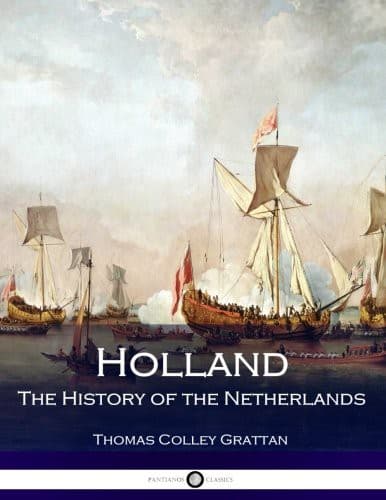
Holland: The History of the Netherlands — John Shaqi
Holland: The History of the NetherlandsGrattan, Thomas Colley
History
Holland: The History of the Netherlands
Grattan, Thomas Colley
Netherlands -- History
But it must be remarked that this metamorphosis affected only
the inhabitants of the high grounds, and the Batavians (who were
in their origin Germans) properly so called. The scanty population
of the rest of the country, endowed with that fidelity to their
ancient customs which characterizes the Saxon race, showed no
tendency to mix with foreigner, rarely figured in their ranks,
and seemed to revolt from the southern refinement which was so
little in harmony with their manners and ways of life. It is
astonishing, at the first view, that those beings, whose whole
existence was a contest against famine or the waves, should show
less inclination than their happier neighbors to receive from
Rome an abundant recompense for their services. But the greater
their difficulty to find subsistence in their native land, the
stronger seemed their attachment; like that of the Switzer to
his barren rocks, or of the mariner to the frail and hazardous
home that bears him afloat on the ocean. This race of patriots
was divided into two separate peoples. Those to the north of
the Rhine were the Frisons; those to the west of the Meuse, the
Menapians, already mentioned.
The Frisons differed little from those early inhabitants of the
coast, who, perched on their high-built huts, fed on fish and
drank the water of the clouds. Slow and successive improvements
taught them to cultivate the beans which grew wild among the
marshes, and to tend and feed a small and degenerate breed of
horned cattle. But if these first steps toward civilization were
slow, they were also sure; and they were made by a race of men
who could never retrograde in a career once begun.
The Menapians, equally repugnant to foreign impressions, made, on
their part, a more rapid progress. They were already a maritime
people, and carried on a considerable commerce with England. It
appears that they exported thither salt, the art of manufacturing
which was well known to them; and they brought back in return
marl, a most important commodity for the improvement of their
land. They also understood the preparation of salting meat, with
a perfection that made it in high repute even in Italy; and,
finally, we are told by Ptolemy that they had established a colony
on the eastern coast of Ireland, not far from Dublin.
Public-domain text, read in full here on John Shaqi.
Reviews
Reviews
No reviews yet
Be the first to share your thoughts on this work.
Join the Discussion
Join the discussion
Sign in to leave a comment or review.
Sign InorCreate an account