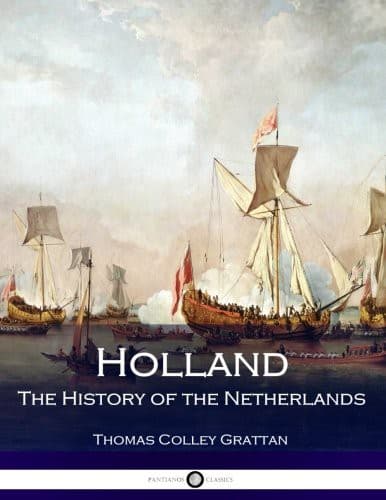
Holland: The History of the NetherlandsGrattan, Thomas Colley
History
Holland: The History of the Netherlands
Grattan, Thomas Colley
Netherlands -- History
To form a counterpoise to the power so lavishly conferred on
Leicester, Prince Maurice was, according to the wise advice of
Olden Barnevelt, raised to the dignity of stadtholder,
captain-general, and admiral of Holland and Zealand. This is
the first instance of these states taking on themselves the
nomination to the dignity of stadtholder, for even William has
held his commission from Philip, or in his name; but Friesland,
Groningen, and Guelders had already appointed their local governors,
under the same title, by the authority of the states-general,
the archduke Mathias, or even of the provincial states. Holland
had now also at the head of its civil government a citizen full
of talent and probity, who was thus able to contend with the
insidious designs of Leicester against the liberty he nominally
came to protect. This was Barnevelt, who was promoted from his
office of pensionary of Rotterdam to that of Holland, and who
accepted the dignity only on condition of being free to resign
it if any accommodation of differences should take place with
Spain.
Alexander of Parma had, by the death of his mother, in February,
1586, exchanged his title of prince for the superior one of duke
of Parma, and soon resumed his enterprises with his usual energy
and success; various operations took place, in which the English
on every opportunity distinguished themselves; particularly in
an action near the town of Grave, in Brabant; and in the taking
of Axel by escalade, under the orders of Sir Philip Sidney. A
more important affair occurred near Zutphen, at a place called
Warnsfeld, both of which towns have given names to the action. On
this occasion the veteran Spaniards, under the marquis of Guasto,
were warmly attacked and completely defeated by the English;
but the victory was dearly purchased by the death of Sir Philip
Sidney, who was mortally wounded in the thigh, and expired a
few days afterward, at the early age of thirty-two years. In
addition to the valor, talent, and conduct, which had united to
establish his fame, he displayed, on this last opportunity of
his short career, an instance of humanity that sheds a new lustre
on even a character like his. Stretched on the battlefield, in all
the agony of his wound, and parched with thirst, his afflicted
followers brought him some water, procured with difficulty at a
distance, and during the heat of the fight. But Sidney, seeing a
soldier lying near, mangled like himself, and apparently expiring,
refused the water, saying, "Give it to that poor man; his sufferings
are greater than mine."
Public-domain text, read in full here on John Shaqi.
Reviews
Reviews
No reviews yet
Be the first to share your thoughts on this work.
Elsewhere in the archive
Join the Discussion
Join the discussion
Sign in to leave a comment or review.
Sign InorCreate an account