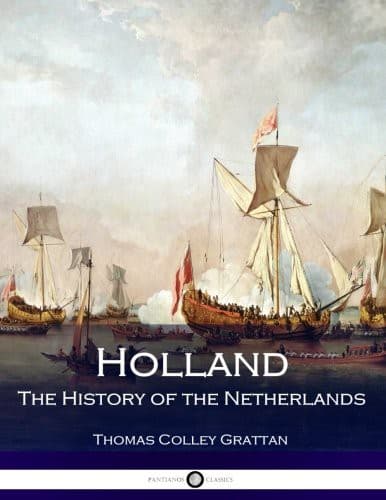
Holland: The History of the NetherlandsGrattan, Thomas Colley
History
Holland: The History of the Netherlands
Grattan, Thomas Colley
Netherlands -- History
The United Provinces were soon without any rival on the seas.
In Europe alone they had one thousand two hundred merchant ships
in activity, and upward of seventy thousand sailors constantly
employed. They built annually two thousand vessels. In the year
1598, eighty ships sailed from their ports for the Indies or
America. They carried on, besides, an extensive trade on the coast
of Guinea, whence they brought large quantities of gold-dust;
and found, in short, in all quarters of the globe the reward of
their skill, industry, and courage.
The spirit of conquest soon became grafted on the habits of trade.
Expedition succeeded to expedition. Failure taught wisdom to
those who did not want bravery. The random efforts of individuals
were succeeded by organized plans, under associations well
constituted and wealthy; and these soon gave birth to those eastern
and western companies before alluded to. The disputes between
the English and the Hanseatic towns were carefully observed by
the Dutch, and turned to their own advantage. The English
manufacturers, who quickly began to flourish, from the influx
of Flemish workmen under the encouragement of Elizabeth, formed
companies in the Netherlands, and sent their cloths into those
very towns of Germany which formerly possessed the exclusive
privilege of their manufacture. These towns naturally felt
dissatisfied, and their complaints were encouraged by the king
of Spain. The English adventurers received orders to quit the
empire; and, invited by the states-general, many of them fixed
their residence in Middleburg, which became the most celebrated
woollen market in Europe.
The establishment of the Jews in the towns of the republic forms
a remarkable epoch in the annals of trade. This people, so outraged
by the loathsome bigotry which Christians have not blushed to
call religion, so far from being depressed by the general
persecution, seemed to find it a fresh stimulus to the exertion
of their industry. To escape death in Spain and Portugal they
took refuge in Holland, where toleration encouraged and just
principles of state maintained them. They were at first taken
for Catholics, and subjected to suspicion; but when their real
faith was understood they were no longer molested.
Astronomy and geography, two sciences so closely allied with and
so essential to navigation, flourished now throughout Europe.
Ortilius of Antwerp, and Gerard Mercator of Rupelmonde, were two
of the greatest geographers of the sixteenth century; and the
reform in the calendar at the end of that period gave stability
to the calculations of time, which had previously suffered all
the inconvenient fluctuations attendant on the old style.
Public-domain text, read in full here on John Shaqi.
Reviews
Reviews
No reviews yet
Be the first to share your thoughts on this work.
Elsewhere in the archive
Join the Discussion
Join the discussion
Sign in to leave a comment or review.
Sign InorCreate an account