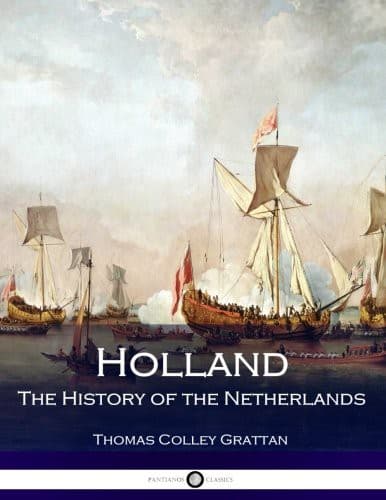
Holland: The History of the NetherlandsGrattan, Thomas Colley
History
Holland: The History of the Netherlands
Grattan, Thomas Colley
Netherlands -- History
The army of Albert now marched on, flushed with this first success
and confident of final victory. Prince Maurice received them
with the courage of a gallant soldier and the precaution of a
consummate general. He had caused the fleet of ships of war and
transports, which had sailed along the coast from Zealand, and
landed supplies of ammunition and provisions, to retire far from
the share, so as to leave to his army no chance of escape but in
victory. The commissioners from the states, who always accompanied
the prince as a council of observation rather than of war, had
retired to Ostend in great consternation, to wait the issue of
the battle which now seemed inevitable. A scene of deep feeling
and heroism was the next episode of this memorable day, and throws
the charm of natural affection over those circumstances in which
glory too seldom leaves a place for the softer emotions of the
heart. When the patriot army was in its position, and firmly
waiting the advance of the foe, Prince Maurice turned to his
brother, Frederick Henry, then sixteen years of age, and several
young noblemen, English, French, and German, who like him attended
on the great captain to learn the art of war: he pointed out
in a few words the perilous situation in which he was placed;
declared his resolution to conquer or perish on the battlefield,
and recommended the boyish band to retire to Ostend, and wait
for some less desperate occasion to share his renown or revenge
his fall. Frederick Henry spurned the affectionate suggestion,
and swore to stand by his brother to the last; and all his young
companions adopted the same generous resolution.
The army of the states was placed in order of battle, about a
league in front of Nieuport, in the sand hills with which the
neighborhood abounds, its left wing resting on the seashore. Its
losses of the morning, and of the garrisons left in the forts
near Bruges, reduced it to an almost exact equality with that of
the archduke. Each of these armies was composed of that variety
of troops which made them respectively an epitome of the various
nations of Europe. The patriot force contained Dutch, English,
French, German, and Swiss, under the orders of Count Louis of
Nassau, Sir Francis and Sir Horace Vere, brothers and English
officers of great celebrity, with other distinguished captains.
The archduke mustered Spaniards, Italians, Walloons, and Irish in
his ranks, led on by Mendoza, La Berlotta, and their fellow-veterans.
Both armies were in the highest state of discipline, trained to
war by long service, and enthusiastic in the several causes which
they served; the two highest principles of enthusiasm urging them
on--religious fanaticism on the one hand, and the love of freedom
on the other. The rival generals rode along their respective
lines, addressed a few brief sentences of encouragement to their
men, and presently the bloody contest began.
Public-domain text, read in full here on John Shaqi.
Reviews
Reviews
No reviews yet
Be the first to share your thoughts on this work.
Elsewhere in the archive
Join the Discussion
Join the discussion
Sign in to leave a comment or review.
Sign InorCreate an account