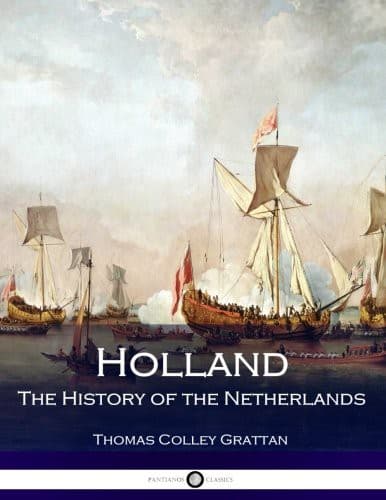
Holland: The History of the NetherlandsGrattan, Thomas Colley
History
Holland: The History of the Netherlands
Grattan, Thomas Colley
Netherlands -- History
It was three o'clock in the afternoon when the archduke commenced
the attack. His advanced guard, commanded by Mendoza and composed
of those former mutineers who now resolved to atone for their
misconduct, marched across the sand-hills with desperate resolution.
They soon came into contact with the English contingent under Francis
Vere, who was desperately wounded in the shock. The assault was
almost irresistible. The English, borne down by numbers, were
forced to give way; but the main body pressed on to their support.
Horace Vere stepped forward to supply his brother's place. Not
an inch of ground more was gained or lost; the firing ceased,
and pikes and swords crossed each other in the resolute conflict
of man to man. The action became general along the whole line.
The two commanders-in-chief were at all points. Nothing could
exceed their mutual display of skill and courage. At length the
Spanish cavalry, broken by the well-directed fire of the patriot
artillery, fell back on their infantry and threw it into confusion.
The archduke at the same instant was wounded by a lance in the
cheek, unhorsed, and forced to quit the field. The report of
his death, and the sight of his war-steed galloping alone across
the field, spread alarm through the royalist ranks. Prince Maurice
saw and seized on the critical moment. He who had so patiently
maintained his position for three hours of desperate conflict
now knew the crisis for a prompt and general advance. He gave
the word and led on to the charge, and the victory was at once
his own.
The defeat of the royalist army was complete. The whole of the
artillery, baggage, standards, and ammunition, fell into the
possession of the conquerors. Night coming on saved those who
fled, and the nature of the ground prevented the cavalry from
consummating the destruction of the whole. As far as the conflicting
accounts of the various historians may be compared and calculated
on, the royalists had three thousand killed, and among them several
officers of rank; while the patriot army, including those who fell
in the morning action, lost something more than half the number.
The archduke, furnished with a fresh horse, gained Bruges in safety;
but he only waited there long enough to join his heroic wife,
with whom he proceeded rapidly to Ghent, and thence to Brussels.
Mendoza was wounded and taken prisoner, and with difficulty saved
by Prince Maurice from the fury of the German auxiliaries.
Public-domain text, read in full here on John Shaqi.
Reviews
Reviews
No reviews yet
Be the first to share your thoughts on this work.
Elsewhere in the archive
Join the Discussion
Join the discussion
Sign in to leave a comment or review.
Sign InorCreate an account