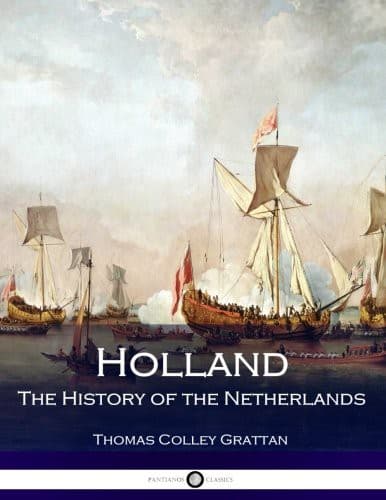
Holland: The History of the NetherlandsGrattan, Thomas Colley
History
Holland: The History of the Netherlands
Grattan, Thomas Colley
Netherlands -- History
The states-general now resolved to confine their military operations
to a war merely defensive. Spinola had, by his conduct during the
late campaign, completely revived the spirits of the Spanish
troops, and excited at least the caution of the Dutch. He now
threatened the United Provinces with invasion; and he exerted his
utmost efforts to raise the supplies necessary for the execution
of his plan. He not only exhausted the resources of the king
of Spain and the archduke, but obtained money on his private
account from all those usurers who were tempted by his confident
anticipations of conquest. He soon equipped two armies of about
twelve thousand men each. At the head of one of those he took
the field; the other, commanded by the count of Bucquoi, was
destined to join him in the neighborhood of Utrecht; and he was
then resolved to push forward with the whole united force into
the very heart of the republic.
Prince Maurice in the meantime concentrated his army, amounting
to twelve thousand men, and prepared to make head against his
formidable opponents. By a succession of the most prudent manoeuvres
he contrived to keep Spinola in check, disconcerted all his projects,
and forced him to content himself with the capture of two or
three towns--a comparatively insignificant conquest. Desiring
to wipe away the disgrace of this discomfiture, and to risk
everything for the accomplishment of his grand design, Spinola
used every method to provoke the prince to a battle, even though a
serious mutiny among his troops, and the impossibility of forming a
junction with Bucquoi, had reduced his force below that of Maurice;
but the latter, to the surprise of all who expected a decisive
blow, retreated from before the Italian general--abandoning the
town of Groll, which immediately fell into Spinola's power, and
giving rise to manifold conjectures and infinite discontent at
conduct so little in unison with his wonted enterprise and skill.
Even Henry IV. acknowledged it did not answer the expectation he
had formed from Maurice's splendid talents for war. The fact
seems to be that the prince, much as he valued victory, dreaded
peace more; and that he was resolved to avoid a decisive blow,
which, in putting an end to the contest, would at the same time
have decreased the individual influence in the state which his
ambition now urged him to augment by every possible means.
Public-domain text, read in full here on John Shaqi.
Reviews
Reviews
No reviews yet
Be the first to share your thoughts on this work.
Elsewhere in the archive
Join the Discussion
Join the discussion
Sign in to leave a comment or review.
Sign InorCreate an account