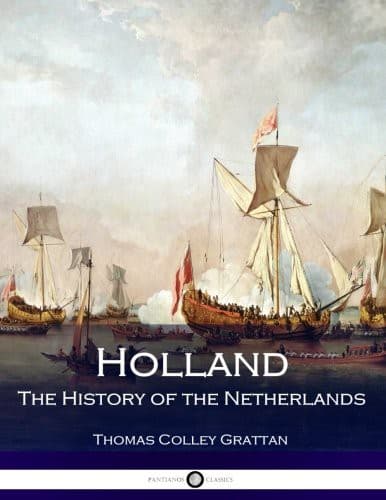
Holland: The History of the NetherlandsGrattan, Thomas Colley
History
Holland: The History of the Netherlands
Grattan, Thomas Colley
Netherlands -- History
The Dutch naval expeditions this year were not more brilliant than
those on land. Admiral Hautain, with twenty ships, was surprised
off Cape St. Vincent by the Spanish fleet. The formidable appearance
of their galleons inspired on this occasion a perfect panic among
the Dutch sailors. They hoisted their sails and fled, with the
exception of one ship, commanded by Vice-Admiral Klaazoon, whose
desperate conduct saved the national honor. Having held out until
his vessel was quite unmanageable, and almost his whole crew
killed or wounded, he prevailed on the rest to agree to the
resolution he had formed, knelt down on the deck, and putting up
a brief prayer for pardon for the act, thrust a light into the
powder-magazine, and was instantly blown up with his companions.
Only two men were snatched from the sea by the Spaniards; and
even these, dreadfully burned and mangled, died in the utterance
of curses on the enemy.
This disastrous occurrence was soon, however, forgotten in the
rejoicings for a brilliant victory gained the following year by
Heemskirk, so celebrated for his voyage to Nova Zembla, and by
his conduct in the East. He set sail from the ports of Holland
in the month of March, determined to signalize himself by some
great exploit, now necessary to redeem the disgrace which had
begun to sully the reputation of the Dutch navy. He soon got
intelligence that the Spanish fleet lay at anchor in the bay
of Gibraltar, and he speedily prepared to offer them battle.
Before the combat began he held a council of war, and addressed
the officers in an energetic speech, in which he displayed the
imperative call on their valor to conquer or die in the approaching
conflict. He led on to the action in his own ship; and, to the
astonishment of both fleets, he bore right down against the enormous
galleon in which the flag of the Spanish admiral-in-chief was
hoisted. D'Avila could scarcely believe the evidence of his eyes
at this audacity: he at first burst into laughter at the notion;
but as Heemskirk approached, he cut his cables and attempted
to escape under the shelter of the town. The heroic Dutchman
pursued him through the whole of the Spanish fleet, and soon
forced him to action. At the second broadside Heemskirk had his
left leg carried off by a cannon-ball, and he almost instantly
died, exhorting his crew to seek for consolation in the defeat
of the enemy. Verhoef, the captain of the ship, concealed the
admiral's death; and the whole fleet continued the action with
a valor worthy the spirit in which it was commenced. The victory
was soon decided: four of the Spanish galleons were sunk or burned,
the remainder fled; and the citizens of Cadiz trembled with the
apprehension of sack and pillage. But the death of Heemskirk,
when made known to the surviving victors, seemed completely to
paralyze them. They attempted nothing further; but sailing back
to Holland with the body of their lamented chief, thus paid a
Public-domain text, read in full here on John Shaqi.
Reviews
Reviews
No reviews yet
Be the first to share your thoughts on this work.
Elsewhere in the archive
Join the Discussion
Join the discussion
Sign in to leave a comment or review.
Sign InorCreate an account