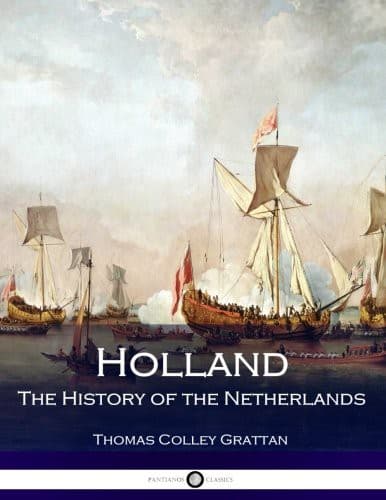
Holland: The History of the NetherlandsGrattan, Thomas Colley
History
Holland: The History of the Netherlands
Grattan, Thomas Colley
Netherlands -- History
greater tribute to his importance than was to be found in the
mausoleum erected to his memory in the city of Amsterdam.
[Illustration: WILLIAM THE SILENT OF ORANGE.]
The news of this battle reaching Brussels before it was known
in Holland, contributed not a little to quicken the anxiety of
the archdukes for peace. The king of Spain, worn out by the war
which drained his treasury, had for some time ardently desired it.
The Portuguese made loud complaints of the ruin that threatened
their trade and their East Indian colonies. The Spanish ministers
were fatigued with the apparently interminable contest which
baffled all their calculations. Spinola, even, in the midst of
his brilliant career, found himself so overwhelmed with debts
and so oppressed by the reproaches of the numerous creditors
who were ruined by his default of payment, that he joined in the
general demand for repose. In the month of May, 1607, proposals
were made by the archdukes, in compliance with the general desire;
and their two plenipotentiaries, Van Wittenhorst and Gevaerts,
repaired to The Hague.
Public opinion in the United Provinces was divided on this important
question. An instinctive hatred against the Spaniards, and long
habits of warfare, influenced the great mass of the people to
consider any overture for peace as some wily artifice aimed at
their religion and liberty. War seemed to open inexhaustible
sources of wealth; while peace seemed to threaten the extinction
of the courage which was now as much a habit as war appeared to
be a want. This reasoning was particularly convincing to Prince
Maurice, whose fame, with a large portion of his authority and
revenues, depended on the continuance of hostilities: it was
also strongly relished and supported in Zealand generally, and
in the chief towns, which dreaded the rivalry of Antwerp. But
those who bore the burden of the war saw the subject under a
different aspect. They feared that the present state of things
would lead to their conquest by the enemy, or to the ruin of
their liberty by the growing power of Maurice. They hoped that
peace would consolidate the republic and cause the reduction
of the debt, which now amounted to twenty-six million florins.
At the head of the party who so reasoned was De Barneveldt; and
his name is a guarantee with posterity for the wisdom of the
opinion.
Public-domain text, read in full here on John Shaqi.
Reviews
Reviews
No reviews yet
Be the first to share your thoughts on this work.
Elsewhere in the archive
Join the Discussion
Join the discussion
Sign in to leave a comment or review.
Sign InorCreate an account