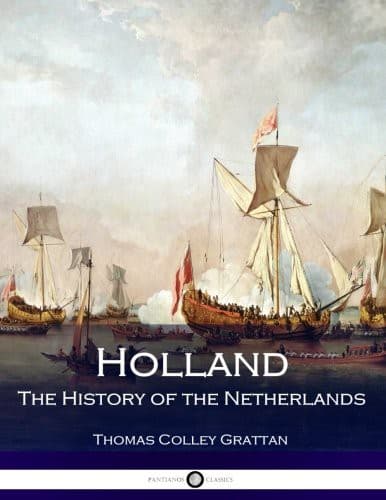
Holland: The History of the NetherlandsGrattan, Thomas Colley
History
Holland: The History of the Netherlands
Grattan, Thomas Colley
Netherlands -- History
We cannot follow the misguided prince in all the winding ways
of intrigue and subterfuge through which he labored to reach his
object. Religion, the holiest of sentiments, and Christianity,
the most sacred of its forms, were perpetually degraded by being
made the pretexts for that unworthy object. He was for a while
diverted from its direct pursuit by the preparation made to afford
assistance to some of the allies of the republic. Fifty thousand
florins a month were granted to the duke of Savoy, who was at
war with Spain; and seven thousand men, with nearly forty ships,
were despatched to the aid of the republic of Venice, in its
contest with Ferdinand, archduke of Gratz, who was afterward
elected emperor. The honorary empire of the seas seems at this
time to have been successfully claimed by the United Provinces.
They paid back with interest the haughty conduct with which they
had been long treated by the English; and they refused to pay
the fishery duties to which the inhabitants of Great Britain
were subject. The Dutch sailors had even the temerity, under
pretext of pursuing pirates, to violate the British territory.
They set fire to the town of Crookhaven, in Ireland, and massacred
several of the inhabitants. King James, immersed in theological
studies, appears to have passed slightly over this outrage. More
was to have been expected from his usual attention to the affairs
of Ireland; his management of which ill-fated country is the
best feature of his political character, and ought, to Irish
feelings at least, to be considered to redeem its many errors.
But he took fire at the news that the states had prohibited the
importation of cloth dyed and dressed in England. It required
the best exertion of Barneveldt's talents to pacify him; and
it was not easy to effect this through the jaundiced medium of
the ambassador Carleton. But it was unanswerably argued by the
pensionary that the manufacture of cloth was one of those ancient
and natural sources of wealth which England had ravished from the
Netherlands, and which the latter was justified in recovering by
every effort consistent with national honor and fair principles
of government.
Public-domain text, read in full here on John Shaqi.
Reviews
Reviews
No reviews yet
Be the first to share your thoughts on this work.
Elsewhere in the archive
Join the Discussion
Join the discussion
Sign in to leave a comment or review.
Sign InorCreate an account