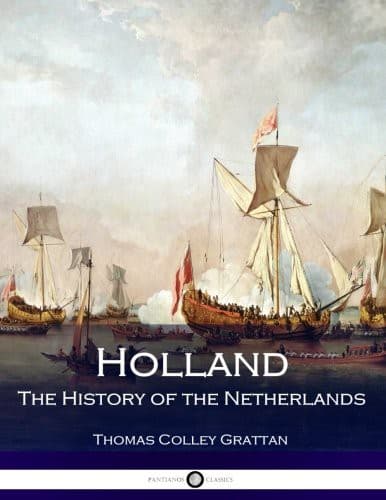
Holland: The History of the NetherlandsGrattan, Thomas Colley
History
Holland: The History of the Netherlands
Grattan, Thomas Colley
Netherlands -- History
The influence of Prince Maurice had gained complete success for
the Calvinist party, in its various titles of Gomarists,
non-remonstrants, etc. The audacity and violence of these ferocious
sectarians knew no bounds. Outrages, too many to enumerate, became
common through the country; and Arminianism was on all sides assailed
and persecuted. Barneveldt frequently appealed to Maurice without
effect; and all the efforts of the former to obtain justice by
means of the civil authorities were paralyzed by the inaction in
which the prince retained the military force. In this juncture,
the magistrates of various towns, spurred on by Barneveldt, called
out the national militia, termed Waardegelders, which possessed
the right of arming at its own expense for the protection of the
public peace. Schism upon schism was the consequence, and the
whole country was reduced to that state of anarchy so favorable
to the designs of an ambitious soldier already in the enjoyment
of almost absolute power. Maurice possessed all the hardihood and
vigor suited to such an occasion. At the head of two companies
of infantry, and accompanied by his brother Frederick Henry, he
suddenly set out at night from The Hague; arrived at the Brille;
and in defiance of the remonstrances of the magistrates, and
in violation of the rights of the town, he placed his devoted
garrison in that important place. To justify this measure, reports
were spread that Barneveldt intended to deliver it up to the
Spaniards; and the ignorant, insensate, and ungrateful people
swallowed the calumny.
This and such minor efforts were, however, all subservient to the
one grand object of utterly destroying, by a public proscription,
the whole of the patriot party, now identified with Arminianism.
A national synod was loudly clamored for by the Gomarists; and in
spite of all opposition on constitutional grounds, it was finally
proclaimed. Uitenbogaard, the enlightened pastor and friend of
Maurice, who on all occasions labored for the general good, now
moderated, as much as possible, the violence of either party; but
he could not persuade Barneveldt to render himself, by compliance,
a tacit accomplice with a measure that he conceived fraught with
violence to the public privileges. He had an inflexible enemy
in Carleton, the English ambassador. His interference carried
the question; and it was at his suggestion that Dordrecht, or
Dort, was chosen for the assembling of the synod. Du Maurier,
the French ambassador, acted on all occasions as a mediator; but
to obtain influence at such a time it was necessary to become
a partisan. Several towns--Leyden, Gouda, Rotterdam, and some
others--made a last effort for their liberties, and formed a
fruitless confederation.
Public-domain text, read in full here on John Shaqi.
Reviews
Reviews
No reviews yet
Be the first to share your thoughts on this work.
Elsewhere in the archive
Join the Discussion
Join the discussion
Sign in to leave a comment or review.
Sign InorCreate an account