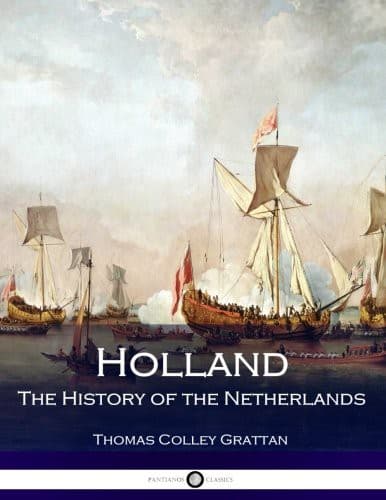
Holland: The History of the NetherlandsGrattan, Thomas Colley
History
Holland: The History of the Netherlands
Grattan, Thomas Colley
Netherlands -- History
and the king of Denmark from the summit of the highest tower in
his besieged capital. A brilliant victory crowned the efforts
of the Dutch admiral, dearly bought by the death of his second in
command, the brave De Witt, and Peter Florizon, another admiral
of note. Relief was poured into Copenhagen. Opdam was replaced
in the command, too arduous for his infirmities, by the still
more celebrated De Ruyter, who was greatly distinguished by his
valor in several successive affairs: and after some months more
of useless obstinacy, the king of Sweden, seeing his army perish
in the island of Funen, by a combined attack of those of Holland
and Denmark, consented to a peace highly favorable to the latter
power.
These transactions placed the United Provinces on a still higher
pinnacle of glory than they had ever reached. Intestine disputes
were suddenly calmed. The Algerines and other pirates were swept
from the seas by a succession of small but vigorous expeditions.
The mediation of the States re-established peace in several of
the petty states of Germany. England and France were both held
in check, if not preserved in friendship, by the dread of their
recovered power. Trade and finance were reorganized. Everything
seemed to promise a long-continued peace and growing greatness,
much of which was owing to the talents and persevering energy of
De Witt; and, to complete the good work of European tranquillity,
the French and Spanish monarchs concluded in this year the treaty
known by the name of the "peace of the Pyrenees."
Cromwell had now closed his career, and Charles II. was restored
to the throne from which he had so long been excluded. The
complimentary entertainments rendered to the restored king in
Holland were on the proudest scale of expense. He left the country
which had given him refuge in misfortune, and done him honor in
his prosperity, with profuse expressions of regard and gratitude.
Scarcely was he established in his recovered kingdom, when a still
greater testimony of deference to his wishes was paid, by the
states-general formally annulling the act of exclusion against
the House of Orange. A variety of motives, however, acting on the
easy and plastic mind of the monarch, soon effaced whatever of
gratitude he had at first conceived. He readily entered into the
views of the English nation, which was irritated by the great
commercial superiority of Holland, and a jealousy excited by
its close connection with France at this period.
Public-domain text, read in full here on John Shaqi.
Reviews
Reviews
No reviews yet
Be the first to share your thoughts on this work.
Elsewhere in the archive
Join the Discussion
Join the discussion
Sign in to leave a comment or review.
Sign InorCreate an account