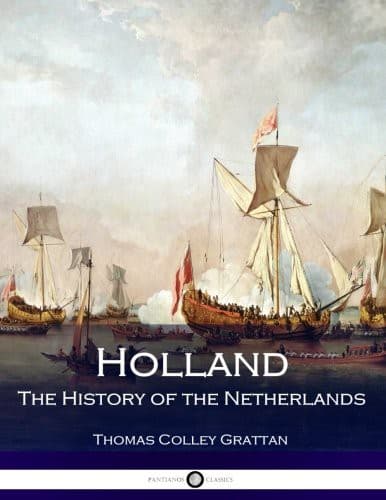
Holland: The History of the NetherlandsGrattan, Thomas Colley
History
Holland: The History of the Netherlands
Grattan, Thomas Colley
Netherlands -- History
It was not till the 22d of February, 1665, that war was formally
declared against the Dutch; but many previous acts of hostility
had taken place in expeditions against their settlements on the
coast of Africa and in America, which were retaliated by De Ruyter
with vigor and success. The Dutch used every possible means of
avoiding the last extremities. De Witt employed all the powers
of his great capacity to avert the evil of war; but nothing could
finally prevent it, and the sea was once more to witness the
conflict between those who claimed its sovereignty. A great battle
was fought on the 31st of June. The duke of York, afterward James
II., commanded the British fleet, and had under him the earl of
Sandwich and Prince Rupert. The Dutch were led on by Opdam; and
the victory was decided in favor of the English by the blowing
up of that admiral's ship, with himself and his whole crew. The
loss of the Dutch was altogether nineteen ships. De Witt the
pensionary then took in person the command of the fleet, which
was soon equipped; and he gave a high proof of the adaptation of
genius to a pursuit previously unknown, by the rapid knowledge
and the practical improvements he introduced into some of the
most intricate branches of naval tactics.
Immense efforts were now made by England, but with a very
questionable policy, to induce Louis XIV. to join in the war.
Charles offered to allow of his acquiring the whole of the Spanish
Netherlands, provided he would leave him without interruption to
destroy the Dutch navy (and, consequently, their commerce), in the
by no means certain expectation that its advantages would all fall
to the share of England. But the king of France resolved to support
the republic. The king of Denmark, too, formed an alliance with
them, after a series of the most strange tergiversations. Spain,
reduced to feebleness, and menaced with invasion by France, showed
no alacrity to meet Charles's overtures for an offensive treaty.
Van Galen, bishop of Munster, a restless prelate, was the only
ally he could acquire. This bishop, at the head of a tumultuous
force of twenty thousand men, penetrated into Friesland; but six
thousand French were despatched by Louis to the assistance of the
republic, and this impotent invasion was easily repelled.
The republic, encouraged by all these favorable circumstances,
resolved to put forward its utmost energies. Internal discords
were once more appeased; the harbors were crowded with merchant
ships; the young Prince of Orange had put himself under the tuition
of the states of Holland and of De Witt, who faithfully executed
his trust; and De Ruyter was ready to lead on the fleet. The
English, in spite of the dreadful calamity of the great fire of
London, the plague which desolated the city, and a declaration
of war on the part of France, prepared boldly for the shock.
Public-domain text, read in full here on John Shaqi.
Reviews
Reviews
No reviews yet
Be the first to share your thoughts on this work.
Elsewhere in the archive
Join the Discussion
Join the discussion
Sign in to leave a comment or review.
Sign InorCreate an account