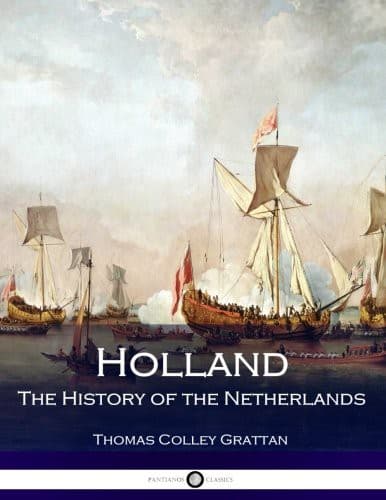
Holland: The History of the NetherlandsGrattan, Thomas Colley
History
Holland: The History of the Netherlands
Grattan, Thomas Colley
Netherlands -- History
The joy in France at William's death was proportionate to the
grief it created in Holland; and the arrogant confidence of Louis
seemed to know no bounds. "I will punish these audacious merchants,"
said he, with an air of disdain, when he read the manifesto of
Holland; not foreseeing that those he affected to despise so
much would, ere long, command in a great measure the destinies
of his crown. Queen Anne entered upon the war with masculine
intrepidity, and maintained it with heroic energy. Efforts were
made by the English ministry and the states-general to mediate
between the kings of Sweden and Poland. But Charles XII., enamored
of glory, and bent on the one great object of his designs against
Russia, would listen to nothing that might lead him from his
immediate career of victory. Many other of the northern princes
were withheld, by various motives, from entering into the contest
with France, and its whole brunt devolved on the original members
of the Grand Alliance. The generals who carried it on were
Marlborough and Prince Eugene. The former, at its commencement
an earl, and subsequently raised to the dignity of duke, was
declared generalissimo of the Dutch and English forces. He was
a man of most powerful genius, both as warrior and politician.
A pupil of the great Turenne, his exploits left those of his
master in the shade. No commander ever possessed in a greater
degree the faculty of forming vast designs, and of carrying them
into effect with consummate skill; no one displayed more coolness
and courage in action, saw with a keener eye the errors of the
enemy, or knew better how to profit by success. He never laid
siege to a town that he did not take, and never fought a battle
that he did not gain.
Prince Eugene joined to the highest order of personal bravery a
profound judgment for the grand movements of war, and a capacity
for the most minute of the minor details on which their successful
issue so often depends. United in the same cause, these two great
generals pursued their course without the least misunderstanding.
At the close of each of those successive campaigns, in which they
reaped such a full harvest of renown, they retired together to The
Hague, to arrange, in the profoundest secrecy, the plans for the
next year's operations, with one other person, who formed the great
point of union between them, and completed a triumvirate without
a parallel in the history of political affairs. This third was
Heinsius, one of those great men produced by the republic whose
names are tantamount to the most detailed eulogium for talent
and patriotism. Every enterprise projected by the confederates
was deliberately examined, rejected, or approved by these three
associates, whose strict union of purpose, disowning all petty
rivalry, formed the centre of counsels and the source of
circumstances finally so fatal to France.
Public-domain text, read in full here on John Shaqi.
Reviews
Reviews
No reviews yet
Be the first to share your thoughts on this work.
Elsewhere in the archive
Join the Discussion
Join the discussion
Sign in to leave a comment or review.
Sign InorCreate an account