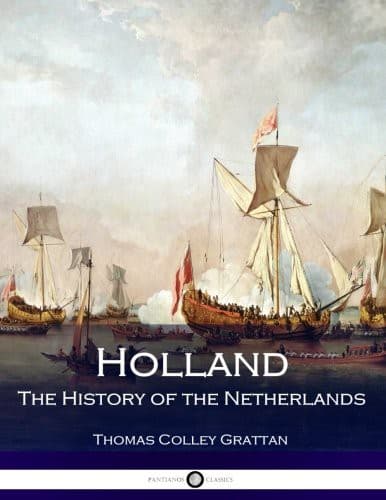
Holland: The History of the NetherlandsGrattan, Thomas Colley
History
Holland: The History of the Netherlands
Grattan, Thomas Colley
Netherlands -- History
The peace was not definitively signed until the 11th of April,
1713; and France obtained far better conditions than those which
were refused her a few years previously. The Belgian provinces
were given to the new emperor, and must henceforth be called
the Austrian instead of the Spanish Netherlands. The gold and
the blood of Holland had been profusely expended during this
contest; it might seem for no positive results; but the exhaustion
produced to every one of the other belligerents was a source
of peace and prosperity to the republic. Its commerce was
re-established; its financial resources recovered their level;
and altogether we must fix on the epoch now before us as that
of its utmost point of influence and greatness. France, on the
contrary, was now reduced from its palmy state of almost European
sovereignty to one of the deepest misery; and its monarch, in
his old age, found little left of his former power but those
records of poetry, painting, sculpture, and architecture which
tell posterity of his magnificence, and the splendor of which
throw his faults and his misfortunes into the shade.
The great object now to be accomplished by the United Provinces
was the regulation of a distinct and guaranteed line of frontier
between the republic and France. This object had become by degrees,
ever since the peace of Munster, a fundamental maxim of their
politics. The interposition of the Belgian provinces between the
republic and France was of serious inconvenience to the former in
this point of view. It was made the subject of a special article in
"the grand alliance." In the year 1707 it was particularly discussed
between England and the States, to the great discontent of the
emperor, who was far from wishing its definitive settlement. But
it was now become an indispensable item in the total of important
measures whose accomplishment was called for by the peace of
Utrecht. Conferences were opened on this sole question at Antwerp
in the year 1714; and, after protracted and difficult discussions,
the treaty of the Barrier was concluded on the 15th of November,
1715.
This treaty was looked on with an evil eye in the Austrian
Netherlands. The clamor was great and general; jealousy of the
commercial prosperity of Holland being the real motive. Long
negotiations took place on the subject of the treaty; and in
December, 1718, the republic consented to modify some of the
articles. The Pragmatic Sanction, published at Vienna in 1713
by Charles VI., regulated the succession to all the imperial
hereditary possessions; and, among the rest, the provinces of
the Netherlands. But this arrangement, though guaranteed by the
chief powers of Europe, was, in the sequel, little respected,
and but indifferently executed.
CHAPTER XXI
FROM THE PEACE OF UTRECHT TO THE INCORPORATION OF BELGIUM WITH
THE FRENCH REPUBLIC
A.D. 1713--1795
Public-domain text, read in full here on John Shaqi.
Reviews
Reviews
No reviews yet
Be the first to share your thoughts on this work.
Elsewhere in the archive
Join the Discussion
Join the discussion
Sign in to leave a comment or review.
Sign InorCreate an account