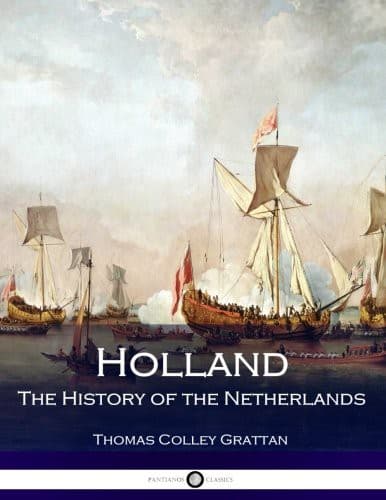
Holland: The History of the NetherlandsGrattan, Thomas Colley
History
Holland: The History of the Netherlands
Grattan, Thomas Colley
Netherlands -- History
During a period of thirty years following the treaty of Utrecht,
the republic enjoyed the unaccustomed blessing of profound peace.
While the discontents of the Austrian Netherlands on the subject
of the treaty of the Barrier were in debate, the quadruple alliance
was formed between Holland, England, France and the emperor, for
reciprocal aid against all enemies, foreign and domestic. It was
in virtue of this treaty that the pretender to the English throne
received orders to remove from France; and the states-general
about the same time arrested the Swedish ambassador, Baron Gortz,
whose intrigues excited some suspicion. The death of Louis XIV.
had once more changed the political system of Europe; and the
commencement of the eighteenth century was fertile in negotiations
and alliances in which we have at present but little direct interest.
The rights of the republic were in all instances respected; and
Holland did not cease to be considered as a power of the first
distinction and consequence. The establishment of an East India
Company at Ostend, by the emperor Charles VI., in 1722, was the
principal cause of disquiet to the United Provinces, and the most
likely to lead to a rupture. But, by the treaty of Hanover in
1726, the rights of Holland resulting from the treaty of Munster
were guaranteed; and in consequence the emperor abolished the
company of his creation, by the treaty of Seville in 1729, and
that of Vienna in 1731.
The peace which now reigned in Europe allowed the United Provinces
to direct their whole efforts toward the reform of those internal
abuses resulting from feudality and fanaticism. Confiscations
were reversed, and property secured throughout the republic.
It received into its protection the persecuted sectarians of
France, Germany, and Hungary; and the tolerant wisdom which it
exercised in these measures gives the best assurance of its justice
and prudence in one of a contrary nature, forming a solitary
exception to them. This was the expulsion of the Jesuits, whose
dangerous and destructive doctrines had been long a warrant for
this salutary example to the Protestant states of Europe.
In the year 1732 the United Provinces were threatened with imminent
peril, which accident alone prevented from becoming fatal to
their very existence. It was perceived that the dikes, which
had for ages preserved the coasts, were in many places crumbling
to ruin, in spite of the enormous expenditure of money and labor
devoted to their preservation. By chance it was discovered that the
beams, piles and other timber works employed in the construction
of the dikes were eaten through in all parts by a species of
sea-worm hitherto unknown. The terror of the people was, as may
be supposed, extreme. Every possible resource was applied which
could remedy the evil; a hard frost providentially set in and
destroyed the formidable reptiles; and the country was thus saved
from a danger tenfold greater than that involved in a dozen wars.
Public-domain text, read in full here on John Shaqi.
Reviews
Reviews
No reviews yet
Be the first to share your thoughts on this work.
Elsewhere in the archive
Join the Discussion
Join the discussion
Sign in to leave a comment or review.
Sign InorCreate an account