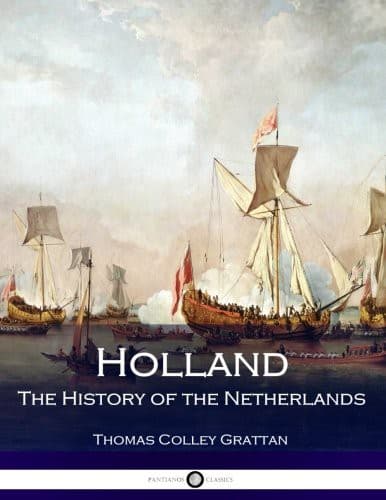
Holland: The History of the NetherlandsGrattan, Thomas Colley
History
Holland: The History of the Netherlands
Grattan, Thomas Colley
Netherlands -- History
The impulsion given to the political mind of Europe by the revolution
in North America was soon felt in the Netherlands. The wish for
reform was not merely confirmed to the people. A memorable instance
was offered by Joseph II., son and successor of Maria Theresa,
that sovereigns were not only susceptible of rational notions
of change, but that the infection of radical extravagance could
penetrate even to the imperial crown. Disgusted by the despotism
exercised by the clergy of Belgium, Joseph commenced his reign
by measures that at once roused a desperate spirit of hostility
in the priesthood, and soon spread among the bigoted mass of the
people, who were wholly subservient to their will. Miscalculating
his own power, and undervaluing that of the priests, the emperor
issued decrees and edicts with a sweeping violence that shocked
every prejudice and roused every passion perilous to the country.
Toleration to the Protestants, emancipation of the clergy from the
papal yoke, reformation in the system of theological instruction,
were among the wholesale measures of the emperor's enthusiasm,
so imprudently attempted and so virulently opposed.
But ere the deep-sown seeds of bigotry ripened to revolt, or
produced the fruit of active resistance in Belgium, Holland had
to endure the mortification of another war with England. The
republic resolved on a futile imitation of the northern powers,
who had adopted the difficult and anomalous system of an armed
neutrality, for the prevention of English domination on the seas.
The right of search, so proudly established by this power, was not
likely to be wrenched from it by manifestoes or remonstrances;
and Holland was not capable of a more effectual warfare. In the
year 1781, St. Eustache, Surinam, Essequibo, and Demerara, were
taken by British valor; and in the following year several of the
Dutch colonies in the East, well fortified but ill defended,
also fell into the hands of England. Almost the whole of those
colonies, the remnants of prodigious power acquired by such
incalculable instances of enterprise and courage, were one by one
assailed and taken. But this did not suffice for the satisfaction
of English objects in the prosecution of the war. It was also
resolved to deprive Holland of the Baltic trade. A squadron of
seven vessels, commanded by Sir Hyde Parker, was encountered on
the Dogher Bank by a squadron of Dutch ships of the same force
under Admiral Zoutman. An action of four hours was maintained
with all the ancient courage which made so many of the memorable
sea-fights between Tromp, De Ruyter, Blake, and Monk drawn battles.
A storm separated the combatants, and saved the honor of each;
for both had suffered alike, and victory had belonged to neither.
The peace of 1784 terminated this short, but, to Holland, fatal
war; the two latter years of which had been, in the petty warfare
of privateering, most disastrous to the commerce of the republic.
Public-domain text, read in full here on John Shaqi.
Reviews
Reviews
No reviews yet
Be the first to share your thoughts on this work.
Elsewhere in the archive
Join the Discussion
Join the discussion
Sign in to leave a comment or review.
Sign InorCreate an account