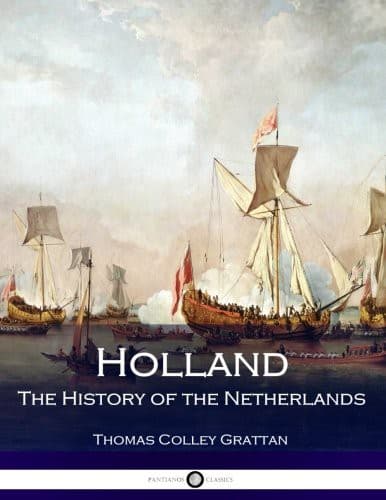
Holland: The History of the NetherlandsGrattan, Thomas Colley
History
Holland: The History of the Netherlands
Grattan, Thomas Colley
Netherlands -- History
But Holland speedily ceased to be a scene of warfare. The
discontented portion of the citizens, now the majority, rejoiced
to retaliate the revolution of 1787 by another, received the French
as liberators. Reduced to extremity, yet still capable by the aid
of his allies of making a long and desperate resistance, the
stadtholder took the nobler resolution of saving his fellow-citizens
from the horrors of prolonged warfare. He repaired to The Hague;
presented himself in the assembly of the states-general; and
solemnly deposited in their hands the exercise of the supreme
power, which he found he could no longer wield but to entail
misery and ruin on his conquered country. After this splendid
instance of true patriotism and rare virtue, he quitted Holland and
took refuge in England. The states-general dissolved a national
assembly installed at The Hague; and, the stadtholderate abolished,
the United Provinces now changed their form of government, their
long-cherished institutions, and their very name, and were christened
the Batavian Republic.
Assurances of the most flattering nature were profusely showered
on the new state, by the sister republic which had effected this
new revolution. But the first measure of regeneration was the
necessity of paying for the recovered independence, which was
effected for the sum of one hundred million florins. The new
constitution was almost entirely modelled on that of France,
and the promised independence soon became a state of deplorable
suffering and virtual slavery. Incalculable evils were the portion
of Holland in the part which she was forced to take in the war
between France and England. Her marine was nearly annihilated,
and some of her most valuable possessions in the Indies ravished
from her by the British arms. She was at the same time obliged
to cede to her ally the whole of Dutch Flanders, Maestricht,
Venloo, and their dependencies; and to render free and common
to both nations the navigation of the Rhine, the Meuse, and the
Scheldt.
The internal situation of the unfortunate republic was deplorable.
Under the weight of an enormous and daily increasing debt, all
the resources of trade and industry were paralyzed. Universal
misery took place of opulence, and not even the consolation of a
free constitution remained to the people. They vainly sought that
blessing from each new government of the country whose destinies
they followed, but whose advantages they did not share. They saw
themselves successively governed by the states-general, a national
assembly, and the directory. But these ephemeral authorities had
not sufficient weight to give the nation domestic happiness,
nor consideration among the other powers.
Public-domain text, read in full here on John Shaqi.
Reviews
Reviews
No reviews yet
Be the first to share your thoughts on this work.
Elsewhere in the archive
Join the Discussion
Join the discussion
Sign in to leave a comment or review.
Sign InorCreate an account