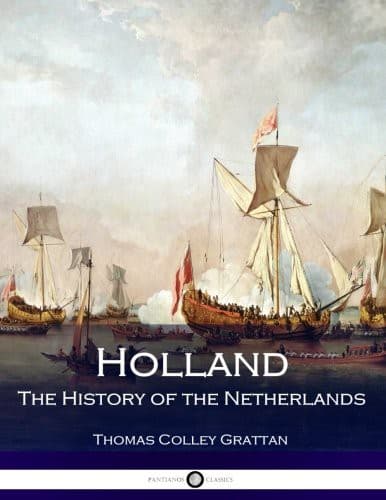
Holland: The History of the NetherlandsGrattan, Thomas Colley
History
Holland: The History of the Netherlands
Grattan, Thomas Colley
Netherlands -- History
On the 11th of October, 1797, the English admiral, Sir Adam Duncan,
with a superior force, encountered the Dutch fleet under De Winter
off Camperdown; and in spite of the bravery of the latter he was
taken prisoner, with nine ships of the line and a frigate. An
expedition on an extensive scale was soon after fitted out in
England, to co-operate with a Russian force for the establishment
of the House of Orange. The Helder was the destination of this
armament, which was commanded by Sir Ralph Abercrombie. The Duke of
York soon arrived in the Texel with a considerable reinforcement.
A series of severe, and well-contested actions near Bergen ended
in the defeat of the allies and the abandonment of the enterprise;
the only success of which was the capture of the remains of the
Dutch fleet, which was safely conveyed to England.
From this period the weight of French oppression became every
day more intolerable in Holland. Ministers, generals, and every
other species of functionary, with swarms of minor tyrants, while
treating the country as a conquered province, deprived it of all
share in the brilliant though checkered glories gained by that
to which it was subservient. The Dutch were robbed of national
independence and personal freedom. While the words "liberty" and
"equality" were everywhere emblazoned, the French ambassador
assumed an almost Oriental despotism. The language and forms of a
free government were used only to sanction a foreign tyranny; and
the Batavian republic, reduced to the most hopeless and degraded
state, was in fact but a forced appendage chained to the triumphal
car of France.
Napoleon Bonaparte, creating by the force of his prodigious talents
the circumstances of which inferior minds are but the creatures, now
rapidly rose to the topmost height of power. He not only towered
above the mass of prejudices which long custom had legalized,
but spurned the multitude by whom these prejudices had been
overthrown. Yet he was not of the first order of great minds;
for he wanted that grand principle of self-control which is the
supreme attribute of greatness. Potent, and almost irresistible
in every conflict with others, and only to be vanquished by his
own acts, he possessed many of the higher qualities of genius.
He was rapid, resolute, and daring, filled with contempt for
the littleness of mankind, yet molding every atom which composed
that littleness to purposes at utter variance with its nature.
In defiance of the first essence of republican theory, he built
himself an imperial throne on the crushed privileges of a prostrate
people; and he lavished titles and dignities on men raised from
its very dregs, with a profusion which made nobility a byword of
scorn. Kingdoms were created for his brothers and his friends;
and the Batavian republic was made a monarchy, to give Louis a
dignity, or at least a title, like the rest.
Public-domain text, read in full here on John Shaqi.
Reviews
Reviews
No reviews yet
Be the first to share your thoughts on this work.
Elsewhere in the archive
Join the Discussion
Join the discussion
Sign in to leave a comment or review.
Sign InorCreate an account