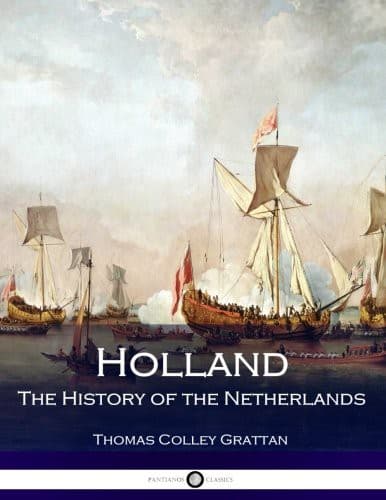
Holland: The History of the NetherlandsGrattan, Thomas Colley
History
Holland: The History of the Netherlands
Grattan, Thomas Colley
Netherlands -- History
The annexation of Holland to the French empire was immediately
pronounced by Napoleon. Two-thirds of the national debt were
abolished, the conscription law was introduced, and the Berlin
and Milan decrees against the introduction of British manufactures
were rigidly enforced. The nature of the evils inflicted on the
Dutch people by this annexation and its consequences demand a
somewhat minute examination. Previous to it all that part of
the territory of the former United Provinces had been ceded to
France. The kingdom of Holland consisted of the departments of
the Zuyder Zee, the mouths of the Maese, the Upper Yssel, the
mouths of the Yssel, Friesland, and the Western and Eastern Ems;
and the population of the whole did not exceed one million eight
hundred thousand souls. When Louis abdicated his throne, he left
a military and naval force of eighteen thousand men, who were
immediately taken into the service of France; and in three years
and a half after that event this number was increased to fifty
thousand, by the operation of the French naval and military code:
thus about a thirty-sixth part of the whole population was employed
in arms. The forces included in the maritime conscription were
wholly employed in the navy. The national guards were on constant
duty in the garrisons or naval establishments. The cohorts were
by law only liable to serve in the _interior_ of the French
empire--that is to say, from Hamburg to Rome; but after the Russian
campaign, this limitation was disregarded, and they formed a
part of Napoleon's army at the battle of Bautzen.
The conscription laws now began to be executed with the greatest
rigor; and though the strictest justice and impartiality were
observed in the ballot and other details of this most oppressive
measure, yet it has been calculated that, on an average, nearly
one-half of the male population of the age of twenty years was
annually taken off. The conscripts were told that their service was
not to extend beyond the term of five years; but as few instances
occurred of a French soldier being discharged without his being
declared unfit for service, it was always considered in Holland
that the service of a conscript was tantamount to an obligation
during life. Besides, the regulations respecting the conscription
were annually changed, by which means the code became each year
more intricate and confused; and as the explanation of any doubt
rested with the functionaries, to whom the execution of the law
was confided, there was little chance of their constructions
mitigating its severity.
Public-domain text, read in full here on John Shaqi.
Reviews
Reviews
No reviews yet
Be the first to share your thoughts on this work.
Elsewhere in the archive
Join the Discussion
Join the discussion
Sign in to leave a comment or review.
Sign InorCreate an account