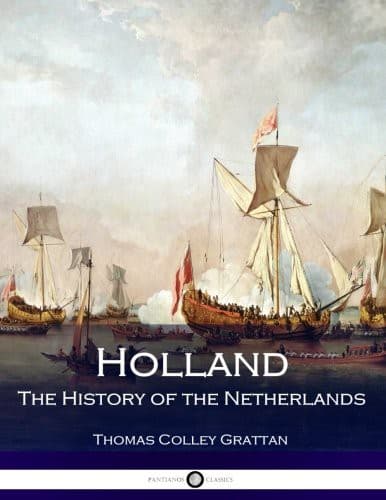
Holland: The History of the NetherlandsGrattan, Thomas Colley
History
Holland: The History of the Netherlands
Grattan, Thomas Colley
Netherlands -- History
But the conscription, however galling, was general in its operation.
Not so the formation of the emperor's guard of honor. The members
of this patrician troop were chosen from the most noble and opulent
families, particularly those who were deemed inimical to the French
connection. The selection depended altogether on the prefect, who
was sure to name those most obnoxious to his political or personal
dislike, without regard to their rank or occupation, or even the
state of their health. No exemption was admitted--not even to
those who from mental or bodily infirmity, or other cause, had
been declared unfit for general military duty. The victims were
forced to the mockery of volunteering their services; obliged to
provide themselves with horses, arms, and accoutrements; and when
arrived at the depot appointed for their assembling, considered
probably but as hostages for the fidelity of their relatives.
The various taxes were laid on and levied in the most oppressive
manner; those on land usually amounting to twenty-five, and those
on houses to thirty per cent of the clear annual rent. Other
direct taxes were levied on persons and movable property, and
all were regulated on a scale of almost intolerable severity. The
whole sum annually obtained from Holland by these means amounted
to about thirty millions of florins (or three million pounds
sterling), being at the rate of about one pound thirteen shillings
four pence from every soul inhabiting the country.
The operation of what was called the continental system created
an excess of misery in Holland, only to be understood by those who
witnessed its lamentable results. In other countries, Belgium for
instance, where great manufactories existed, the loss of maritime
communication was compensated by the exclusion of English goods. In
states possessed of large and fertile territories, the population
which could no longer be employed in commerce might be occupied
in agricultural pursuits. But in Holland, whose manufactures were
inconsiderable, and whose territory is insufficient to support
its inhabitants, the destruction of trade threw innumerable
individuals wholly out of employment, and produced a graduated
scale of poverty in all ranks. A considerable part of the population
had been employed in various branches of the traffic carried on
by means of the many canals which conveyed merchandise from the
seaports into the interior, and to the different continental
markets. When the communication with England was cut off, principals
and subordinates were involved in a common ruin.
Public-domain text, read in full here on John Shaqi.
Reviews
Reviews
No reviews yet
Be the first to share your thoughts on this work.
Elsewhere in the archive
Join the Discussion
Join the discussion
Sign in to leave a comment or review.
Sign InorCreate an account