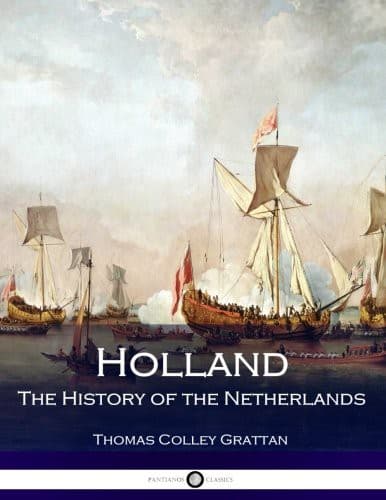
Holland: The History of the NetherlandsGrattan, Thomas Colley
History
Holland: The History of the Netherlands
Grattan, Thomas Colley
Netherlands -- History
Those who have considered the events noted in this history for
the last two hundred years, and followed the fluctuations of
public opinion depending on prosperity or misfortune, will have
anticipated that, in the present calamitous state of the country,
all eyes were turned toward the family whose memory was revived by
every pang of slavery, and associated with every throb for freedom.
The presence of the Prince of Orange, William IV., who had, on
the death of his father, succeeded to the title, though he had
lost the revenues of his ancient house, and the re-establishment
of the connection with England, were now the general desire.
Some of the principal partisans of the House of Nassau were for
some time in correspondence with his most serene highness. The
leaders of the various parties into which the country was divided
became by degrees more closely united. Approaches toward a better
understanding were reciprocally made; and they ended in a general
anxiety for the expulsion of the French, with the establishment
of a free constitution, and a cordial desire that the Prince of
Orange should be at its head. It may be safely affirmed, that,
at the close of the year 1813, these were the unanimous wishes
of the Dutch nation.
Napoleon, lost in the labyrinths of his exorbitant ambition,
afforded at length a chance of redress to the nations he had
enslaved. Elevated so suddenly and so high, he seemed suspended
between two influences, and unfit for either. He might, in a
moral view, be said to have breathed badly, in a station which
was beyond the atmosphere of his natural world, without being
out of its attraction; and having reached the pinnacle, he soon
lost his balance and fell. Driven from Russia by the junction of
human with elemental force, in 1812, he made some grand efforts
in the following year to recover from his irremediable reverses.
The battles of Bautzen and Lutzen were the expiring efforts of
his greatness. That of Leipzig put a fatal negative upon the
hopes that sprang from the two former; and the obstinate ambition,
which at this epoch made him refuse the most liberal offers of
the allies, was justly punished by humiliation and defeat. Almost
all the powers of Europe now leagued against him; and France
itself being worn out by his wasteful expenditure of men and
money, he had no longer a chance in resistance. The empire was
attacked at all points. The French troops in Holland were drawn
off to reinforce the armies in distant directions; and the whole
military force in that country scarcely exceeded ten thousand
men. The advance of the combined armies toward the frontiers
became generally known: parties of Cossacks had entered the north
of Holland in November, and were scouring the country beyond the
Yssel. The moment for action on the part of the Dutch confederate
patriots had now arrived; and it was not lost or neglected.
Public-domain text, read in full here on John Shaqi.
Reviews
Reviews
No reviews yet
Be the first to share your thoughts on this work.
Elsewhere in the archive
Join the Discussion
Join the discussion
Sign in to leave a comment or review.
Sign InorCreate an account