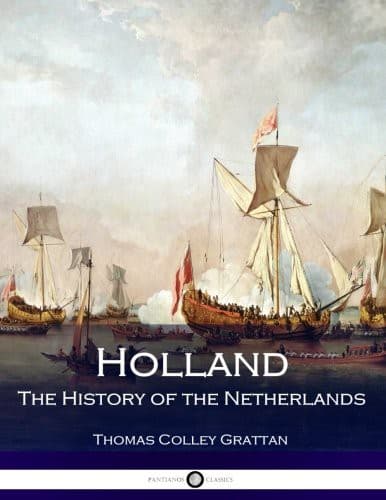
Holland: The History of the NetherlandsGrattan, Thomas Colley
History
Holland: The History of the Netherlands
Grattan, Thomas Colley
Netherlands -- History
In France, the effect of the continental system was somewhat
alleviated by the license trade, the exportation of various
productions forced on the rest of continental Europe, and the
encouragement given to home manufactures. But all this was reversed
in Holland: the few licenses granted to the Dutch were clogged
with duties so exorbitant as to make them useless; the duties on
one ship which entered the Maese, loaded with sugar and coffee,
amounting to about fifty thousand pounds sterling. At the same
time every means was used to crush the remnant of Dutch commerce
and sacrifice the country to France. The Dutch troops were clothed
and armed from French manufactories; the frontiers were opened
to the introduction of French commodities duty free; and the
Dutch manufacturer undersold in his own market.
The population of Amsterdam was reduced from two hundred and
twenty thousand souls to one hundred and ninety thousand, of which
a fourth part derived their whole subsistence from charitable
institutions, while another fourth part received partial succor
from the same sources. At Haarlem, where the population had been
chiefly employed in bleaching and preparing linen made in Brabant,
whole streets were levelled with the ground, and more than five
hundred houses destroyed. At The Hague, at Delft, and in other
towns, many inhabitants had been induced to pull down their houses,
from inability to keep them in repair or pay the taxes. The
preservation of the dikes, requiring an annual expense of six
hundred thousand pounds sterling, was everywhere neglected. The
sea inundated the country, and threatened to resume its ancient
dominion. No object of ambition, no source of professional wealth
or distinction, remained to which a Hollander could aspire. None
could voluntarily enter the army or navy, to fight for the worst
enemy of Holland. The clergy were not provided with a decent
competency. The ancient laws of the country, so dear to its pride
and its prejudices, were replaced by the Code Napoleon; so that
old practitioners had to recommence their studies, and young
men were disgusted with the drudgery of learning a system which
was universally pronounced unfit for a commercial country.
Independent of this mass of positive ill, it must be borne in
mind that in Holland trade was not merely a means of gaining
wealth, but a passion long and deeply grafted on the national
mind: so that the Dutch felt every aggravation of calamity,
considering themselves degraded and sacrificed by a power which
had robbed them of all which attaches a people to their native
land; and, for an accumulated list of evils, only offered them
the empty glory of appertaining to the country which gave the
law to all the nations of Europe, with the sole exception of
England.
Public-domain text, read in full here on John Shaqi.
Reviews
Reviews
No reviews yet
Be the first to share your thoughts on this work.
Elsewhere in the archive
Join the Discussion
Join the discussion
Sign in to leave a comment or review.
Sign InorCreate an account