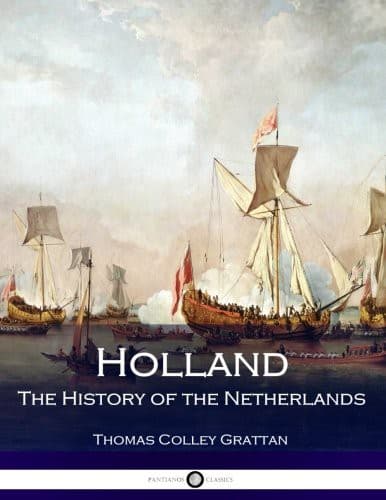
Holland: The History of the NetherlandsGrattan, Thomas Colley
History
Holland: The History of the Netherlands
Grattan, Thomas Colley
Netherlands -- History
The German emperors vainly
interposed for the relief of their unfortunate vassals. Finally,
an agreement was entered into, in the year 882, with Godfrey the
king or leader of the Normans, by which a peace was purchased
on condition of paying him a large subsidy, and ceding to him the
government of Friesland. But, in about two years from this period,
the fierce barbarian began to complain that the country he had
thus gained did not produce grapes, and the present inspiration
of his rapacity seemed to be the blooming vineyards of France.
The emperor Charles the Fat, anticipating the consequence of a
rupture with Godfrey, enticed him to an interview, in which he
caused him to be assassinated. His followers, attacked on all points
by the people of Friesland, perished almost to a man; and their
destruction was completed, in 891, by Arnoul the Germanic. From
that period, the scourge of Norman depredation became gradually
less felt. They now made but short and desultory attempts on the
coast; and their last expedition appears to have taken place
about the year 1000, when they threatened, but did not succeed
in seizing on, the city of Utrecht.
It is remarkable that, although for the space of one hundred and
fifty years the Netherlands were continually the scene of invasion
and devastation by these northern barbarians, the political state
of the country underwent no important changes. The emperors of
Germany were sovereigns of the whole country, with the exception of
Flanders. These portions of the empire were still called Lorraine,
as well as all which they possessed of what is now called France,
and which was that part forming the appanage of Lothaire and of the
Lotheringian kings. The great difficulty of maintaining subordination
among the numerous chieftains of this country caused it, in 958,
to be divided into two governments, which were called Higher and
Lower Lorraine. The latter portion comprised nearly the whole
of the Netherlands, which thus became governed by a lieutenant of
the emperors. Godfrey count of Ardenne was the first who filled
this place; and he soon felt all the perils of the situation. The
other counts saw, with a jealous eye, their equal now promoted
into a superior. Two of the most powerful, Lambert and Reginald,
were brothers. They made common cause against the new duke; and
after a desperate struggle, which did not cease till the year
985, they gained a species of imperfect independence--Lambert
becoming the root from which sprang the counts of Louvain, and
Reginald that of the counts of Hainault.
Public-domain text, read in full here on John Shaqi.
Reviews
Reviews
No reviews yet
Be the first to share your thoughts on this work.
Join the Discussion
Join the discussion
Sign in to leave a comment or review.
Sign InorCreate an account