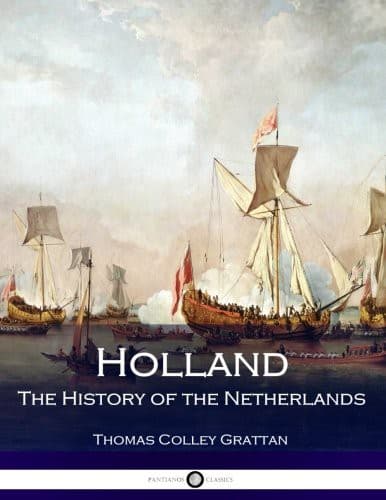
Holland: The History of the NetherlandsGrattan, Thomas Colley
History
Holland: The History of the Netherlands
Grattan, Thomas Colley
Netherlands -- History
unmixed with envy, "I thought myself the only queen here; but
I see six hundred others who appear more so than I."
The court of Phillip the Good seemed to carry magnificence and
splendor to their greatest possible height. The dresses of both
men and women at this chivalric epoch were of almost incredible
expense. Velvet, satin, gold, and precious stones seemed the
ordinary materials for the dress of either sex; while the very
housings of the horses sparkled with brilliants and cost immense
sums. This absurd extravagance was carried so far that Charles
V. found himself forced at length to proclaim sumptuary laws
for its repression.
The style of the banquets given on grand occasions was regulated
on a scale of almost puerile splendor. The Banquet of Vows given
at Lille, in the year 1453, and so called from the obligations
entered into by some of the nobles to accompany Philip in a new
crusade against the infidels, showed a succession of costly
fooleries, most amusing in the detail given by an eye-witness
(Olivier de la Marche), the minutest of the chroniclers, but
unluckily too long to find a place in our pages.
Such excessive luxury naturally led to great corruption of manners
and the commission of terrible crimes. During the reign of Philip de
Male, there were committed in the city of Ghent and its outskirts, in
less than a year, above fourteen hundred murders in gambling-houses
and other resorts of debauchery. As early as the tenth century,
the petty sovereigns established on the ruins of the empire of
Charlemagne began the independent coining of money; and the various
provinces were during the rest of this epoch inundated with a most
embarrassing variety of gold, silver, and copper. Even in ages of
comparative darkness, literature made feeble efforts to burst
through the entangled weeds of superstition, ignorance, and war.
In the fourteenth and fifteenth centuries, history was greatly
cultivated; and Froissart, Monstrelet, Olivier de la Marche, and
Philip de Comines, gave to their chronicles and memoirs a charm
of style since their days almost unrivalled. Poetry began to be
followed with success in the Netherlands, in the Dutch, Flemish,
and French languages; and even before the institution of the
Floral Games in France, Belgium possessed its chambers of rhetoric
(_rederykkamers_) which labored to keep alive the sacred flame
of poetry with more zeal than success. In the fourteenth and
fifteenth centuries, these societies were established in almost
every burgh of Flanders and Brabant; the principal towns possessing
several at once.
Public-domain text, read in full here on John Shaqi.
Reviews
Reviews
No reviews yet
Be the first to share your thoughts on this work.
Elsewhere in the archive
Join the Discussion
Join the discussion
Sign in to leave a comment or review.
Sign InorCreate an account