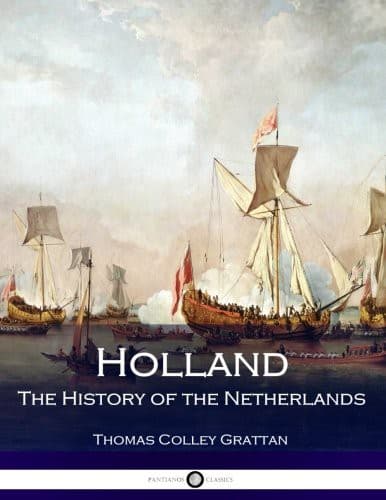
Holland: The History of the NetherlandsGrattan, Thomas Colley
History
Holland: The History of the Netherlands
Grattan, Thomas Colley
Netherlands -- History
The arts in their several branches made considerable progress
in the Netherlands during this epoch. Architecture was greatly
cultivated in the thirteenth and fourteenth centuries; most of
the cathedrals and town houses being constructed in that age.
Their vastness, solidity, and beauty of design and execution,
make them still speaking monuments of the stern magnificence
and finished taste of the times. The patronage of Philip the
Good, Charles the Rash, and Margaret of Austria, brought music
into fashion, and led to its cultivation in a remarkable degree.
The first musicians of France were drawn from Flanders; and other
professors from that country acquired great celebrity in Italy
for their scientific improvements in their delightful art.
Painting, which had languished before the fifteenth century,
sprung at once into a new existence from the invention of John Van
Eyck, known better by the name of John of Bruges. His accidental
discovery of the art of painting in oil quickly spread over Europe,
and served to perpetuate to all time the records of the genius
which has bequeathed its vivid impressions to the world. Painting
on glass, polishing diamonds, the Carillon, lace, and tapestry,
were among the inventions which owed their birth to the Netherlands
in these ages, when the faculties of mankind sought so many new
channels for mechanical development. The discovery of a new world
by Columbus and other eminent navigators gave a fresh and powerful
impulse to European talent, by affording an immense reservoir for
its reward. The town of Antwerp was, during the reign of Charles
V., the outlet for the industry of Europe, and the receptacle
for the productions of all the nations of the earth. Its port
was so often crowded with vessels that each successive fleet
was obliged to wait long in the Scheldt before it could obtain
admission for the discharge of its cargoes. The university of
Louvain, that great nursery of science, was founded in 1425, and
served greatly to the spread of knowledge, although it degenerated
into the hotbed of those fierce disputes which stamped on theology
the degradation of bigotry, and drew down odium on a study that,
if purely practiced, ought only to inspire veneration.
Charles V. was the first to establish a solid plan of government,
instead of the constant fluctuations in the management of justice,
police, and finance. He caused the edicts of the various sovereigns,
and the municipal usages, to be embodied into a system of laws; and
thus gave stability and method to the enjoyment of the prosperity
in which he left his dominions.
CHAPTER VII
FROM THE ACCESSION OF PHILIP II. OF SPAIN TO THE ESTABLISHMENT
OF THE INQUISITION IN THE NETHERLANDS
A.D. 1555--1566
Public-domain text, read in full here on John Shaqi.
Reviews
Reviews
No reviews yet
Be the first to share your thoughts on this work.
Elsewhere in the archive
Join the Discussion
Join the discussion
Sign in to leave a comment or review.
Sign InorCreate an account