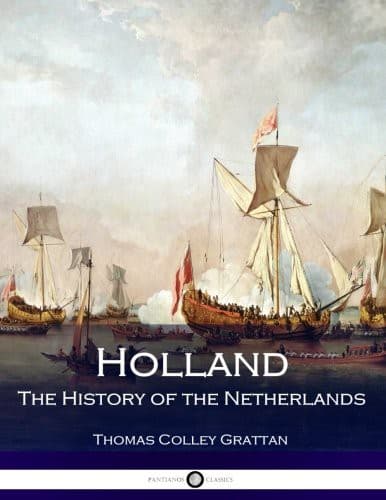
Holland: The History of the NetherlandsGrattan, Thomas Colley
History
Holland: The History of the Netherlands
Grattan, Thomas Colley
Netherlands -- History
consuls of the present times; and loans of immense amount were
frequently negotiated by them with wealthy merchants, who furnished
them, not in negotiable bills or for unredeemable debentures,
but in solid gold, and on a simple acknowledgment.
Flanders and Brabant were still the richest and most flourishing
portions of the state. Some municipal fêtes given about this time
afford a notion of their opulence. On one of these occasions
the town of Mechlin sent a deputation to Antwerp, consisting
of three hundred and twenty-six horsemen dressed in velvet and
satin with gold and silver ornaments; while those of Brussels
consisted of three hundred and forty, as splendidly equipped, and
accompanied by seven huge triumphal chariots and seventy-eight
carriages of various constructions--a prodigious number for those
days.
But the splendor and prosperity which thus sprung out of the
national industry and independence, and which a wise or a generous
sovereign would have promoted, or at least have established on a
permanent basis, was destined speedily to sink beneath the bigoted
fury of Philip II. The new government which he had established
was most ingeniously adapted to produce every imaginable evil
to the state. The king, hundreds of leagues distant, could not
himself issue an order but with a lapse of time ruinous to any
object of pressing importance. The stadtholderess, who represented
him, having but a nominal authority, was forced to follow her
instructions, and liable to have all her acts reversed; besides
which, she had the king's orders to consult her private council
on all affairs whatever, and the council of state on any matter
of paramount importance. These two councils, however, contained
the elements of a serious opposition to the royal projects, in
the persons of the patriot nobles sprinkled among Philip's devoted
creatures. Thus the influence of the crown was often thwarted, if
not actually balanced; and the proposals which emanated from it
frequently opposed by the stadtholderess herself. She, although
a woman of masculine appearance and habits,[2] was possessed
of no strength of mind. Her prevailing sentiment seemed to be
dread of the king; yet she was at times influenced by a sense
of justice, and by the remonstrances of the well-judging members
of her councils. But these were not all the difficulties that
clogged the machinery of the state. After the king, the government,
and the councils, had deliberated on any measure, its execution
rested with the provincial governors or stadtholders, or the
magistrates of the towns. Almost everyone of these, being strongly
attached to the laws and customs of the nation, hesitated, or
refused to obey the orders conveyed to them, when those orders
appeared illegal. Some, however, yielded to the authority of
the government; so it often happened that an edict, which in one
district was carried into full effect, was in others deferred,
rejected, or violated, in a way productive of great confusion
Public-domain text, read in full here on John Shaqi.
Reviews
Reviews
No reviews yet
Be the first to share your thoughts on this work.
Elsewhere in the archive
Join the Discussion
Join the discussion
Sign in to leave a comment or review.
Sign InorCreate an account