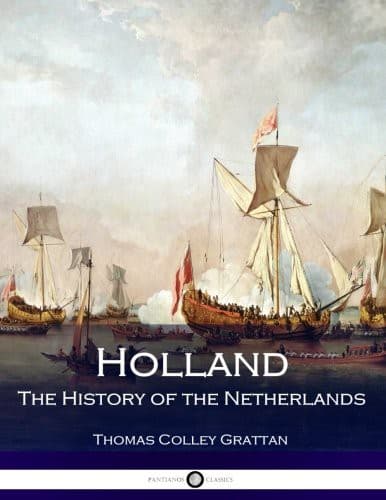
Holland: The History of the NetherlandsGrattan, Thomas Colley
History
Holland: The History of the Netherlands
Grattan, Thomas Colley
Netherlands -- History
in the public affairs.
[Footnote 2: Strada.]
Philip was conscious that he had himself to blame for the consequent
disorder. In nominating the members of the two councils, he had
overreached himself in his plan for silently sapping the liberty
that was so obnoxious to his designs. But to neutralize the influence
of the restive members, he had left Granvelle the first place
in the administration. This man, an immoral ecclesiastic, an
eloquent orator, a supple courtier, and a profound politician,
bloated with pride, envy, insolence, and vanity, was the real
head of the government.[3] Next to him among the royalist party
was Viglius, president of the privy council, an erudite schoolman,
attached less to the broad principles of justice than to the letter
of the laws, and thus carrying pedantry into the very councils of
the state. Next in order came the count de Berlaimont, head of
the financial department--a stern and intolerant satellite of the
court, and a furious enemy to those national institutions which
operated as checks upon fraud. These three individuals formed
the stadtholderess's privy council. The remaining creatures of
the king were mere subaltern agents.
[Footnote 3: Strada, a royalist, a Jesuit, and therefore a fair
witness on this point, uses the following words in portraying the
character of this odious minister: _Animum_avidum_invidumque,_ac_
_simultates_inter_principem_et_populos_occulti_foventum_.]
A government so composed could scarcely fail to excite discontent
and create danger to the public weal. The first proof of incapacity
was elicited by the measures required for the departure of the
Spanish troops. The period fixed by the king had already expired,
and these obnoxious foreigners were still in the country, living
in part on pillage, and each day committing some new excess.
Complaints were carried in successive gradation from the government
to the council, and from the council to the king. The Spaniards
were removed to Zealand; but instead of being embarked at any of
its ports, they were detained there on various pretexts. Money,
ships, or, on necessity, a wind, was professed to be still wanting
for their final removal, by those who found excuses for delay in
every element of nature or subterfuge of art. In the meantime
those ferocious soldiers ravaged a part of the country. The simple
natives at length declared they would open the sluices of their
dikes; preferring to be swallowed by the waters rather than remain
exposed to the cruelty and rapacity of those Spaniards. Still
the embarkation was postponed; until the king, requiring his
troops in Spain for some domestic project, they took their
long-desired departure in the beginning of the year 1561.
Public-domain text, read in full here on John Shaqi.
Reviews
Reviews
No reviews yet
Be the first to share your thoughts on this work.
Elsewhere in the archive
Join the Discussion
Join the discussion
Sign in to leave a comment or review.
Sign InorCreate an account