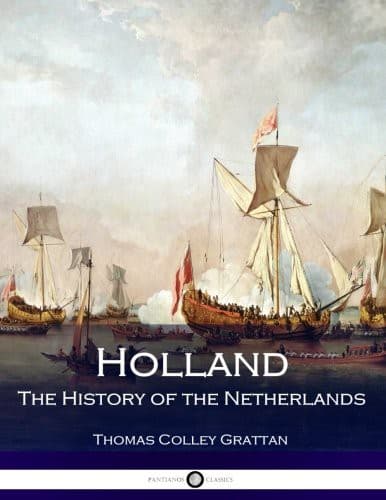
Holland: The History of the NetherlandsGrattan, Thomas Colley
History
Holland: The History of the Netherlands
Grattan, Thomas Colley
Netherlands -- History
The new bishops were to a man most violent, intolerant, and it
may be conscientious, opponents to the wide-spreading doctrines
of reform. The execution of the edicts against heresy was confided
to them. The provincial governors and inferior magistrates were
commanded to aid them with a strong arm; and the most unjust and
frightful persecution immediately commenced. But still some of
these governors and magistrates, considering themselves not only
the officers of the prince, but the protectors of the people,
and the defenders of the laws rather than of the faith, did not
blindly conform to those harsh and illegal commands. The Prince
of Orange, stadtholder of Holland, Zealand, and Utrecht, and
the count of Egmont, governor of Flanders and Artois, permitted
no persecutions in those five provinces. But in various places
the very people, even when influenced by their superiors, openly
opposed it. Catholics as well as Protestants were indignant at
the atrocious spectacles of cruelty presented on all sides. The
public peace was endangered by isolated acts of resistance, and
fears of a general insurrection soon became universal.
The apparent temporizing or seeming uncertainty of the champions
of the new doctrines formed the great obstacle to the reformation,
and tended to prolong the dreadful struggle which was now only
commencing in the Low Countries. It was a matter of great difficulty
to convince the people that popery was absurd, and at the same time
to set limits to the absurdity. Had the change been from blind
belief to total infidelity, it would (as in a modern instance)
have been much easier, though less lasting. Men might, in a time
of such excitement, have been persuaded that _all_ religion
productive of abuses such as then abounded was a farce, and that
common sense called for its abolition. But when the boundaries
of belief became a question; when the world was told it ought to
reject some doctrines, and retain others which seemed as difficult
of comprehension; when one tenet was pronounced idolatry, and
to doubt another declared damnation--the world either exploded
or recoiled: it went too far or it shrank back; plunged into
atheism, or relapsed into popery. It was thus the reformation
was checked in the first instance. Its supporters were the
strong-minded and intelligent; and they never, and least of all
in those days, formed the mass. Superstition and bigotry had
enervated the intellects of the majority; and the high resolve
of those with whom the great work commenced was mixed with a
severity that materially retarded its progress. For though personal
interests, as with Henry VIII. of England, and rigid enthusiasm,
as with Calvin, strengthened the infant reformation; the first
led to violence which irritated many, the second to austerity
which disgusted them; and it was soon discovered that the change
was almost confined to forms of practice, and that the essentials
of abuse were likely to be carefully preserved. All these, and
Public-domain text, read in full here on John Shaqi.
Reviews
Reviews
No reviews yet
Be the first to share your thoughts on this work.
Elsewhere in the archive
Join the Discussion
Join the discussion
Sign in to leave a comment or review.
Sign InorCreate an account