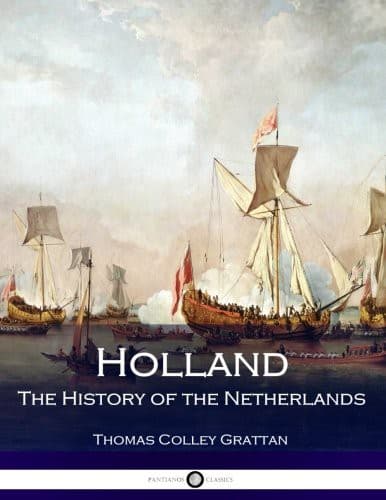
Holland: The History of the NetherlandsGrattan, Thomas Colley
History
Holland: The History of the Netherlands
Grattan, Thomas Colley
Netherlands -- History
The veil was thus rent asunder which had in some measure concealed
the deformity of Philip's despotism. The result was a powerful
confederacy, among all who held it odious, for the overthrow of
Granvelle, to whom they chose to attribute the king's conduct; thus
bringing into practical result the sound principle of ministerial
responsibility, without which, except in some peculiar case of
local urgency or political crisis, the name of constitutional
government is but a mockery. Many of the royalist nobles united
for the national cause; and even the stadtholderess joined her
efforts to theirs, for an object which would relieve her from
the tyranny which none felt more than she did. Those who composed
this confederacy against the minister were actuated by a great
variety of motives. The duchess of Parma hated him, as a domestic
spy robbing her of all real authority; the royalist nobles, as
an insolent upstart at every instant mortifying their pride.
The counts Egmont and Horn, with nobler sentiments, opposed him
as the author of their country's growing misfortunes. But it is
doubtful if any of the confederates except the Prince of Orange
clearly saw that they were putting themselves in direct and personal
opposition to the king himself. William alone, clear-sighted
in politics and profound in his views, knew, in thus devoting
himself to the public cause, the adversary with whom he entered
the lists.
This great man, for whom the national traditions still preserve
the sacred title of "father" (Vader-Willem), and who was in truth
not merely the parent but the political creator of the country,
was at this period in his thirtieth year. He already joined the
vigor of manhood to the wisdom of age. Brought up under the eye
of Charles V., whose sagacity soon discovered his precocious
talents, he was admitted to the councils of the emperor at a
time of life which was little advanced beyond mere boyhood. He
alone was chosen by this powerful sovereign to be present at
the audiences which he gave to foreign ambassadors, which proves
that in early youth he well deserved by his discretion the surname
of "the taciturn." It was on the arm of William, then twenty
years of age, and already named by him to the command of the
Belgian troops, that this powerful monarch leaned for support on
the memorable day of his abdication; and he immediately afterward
employed him on the important mission of bearing the imperial
crown to his brother Ferdinand, in whose favor he had resigned
it. William's grateful attachment to Charles did not blind him
to the demerits of Philip. He repaired to France, as one of the
hostages on the part of the latter monarch for the fulfilment
of the peace of Câteau-Cambresis; and he then learned from the
lips of Henry II., who soon conceived a high esteem for him,
the measures reciprocally agreed on by the two sovereigns for
the oppression of their subjects. From that moment his mind was
Public-domain text, read in full here on John Shaqi.
Reviews
Reviews
No reviews yet
Be the first to share your thoughts on this work.
Elsewhere in the archive
Join the Discussion
Join the discussion
Sign in to leave a comment or review.
Sign InorCreate an account