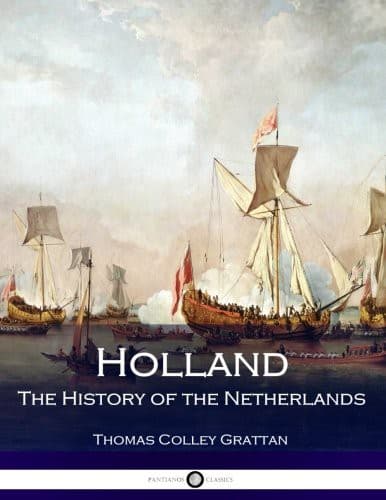
Holland: The History of the NetherlandsGrattan, Thomas Colley
History
Holland: The History of the Netherlands
Grattan, Thomas Colley
Netherlands -- History
Even while the council of state held its sittings, the report was
spread through Brussels that the confederates were approaching.
And at length they did enter the city, to the amount of some
hundreds of the representatives of the first families in the
country. On the following day, the 5th of April, 1566, they walked
in solemn procession to the palace. Their demeanor was highly
imposing, from their mingled air of forbearance and determination.
All Brussels thronged out to gaze and sympathize with this
extraordinary spectacle of men whose resolute step showed they
were no common suppliants, but whose modest bearing had none
of the seditious air of faction. The stadtholderess received
the distinguished petitioners with courtesy, listened to their
detail of grievances, and returned a moderate, conciliatory,
but evasive answer.
The confederation, which owed its birth to, and was cradled in
social enjoyments, was consolidated in the midst of a feast.
The day following this first deputation to the stadtholderess,
De Brederode gave a grand repast to his associates in the Hotel
de Culembourg. Three hundred guests were present. Inflamed by
joy and hope, their spirits rose high under the influence of
wine, and temperance gave way to temerity. In the midst of their
carousing, some of the members remarked that when the stadtholderess
received the written petition, Count Berlaimont observed to her
that "she had nothing to fear from such a band of beggars"
(_tas_de_GUEUX_). The fact was that many of the confederates
were, from individual extravagance and mismanagement, reduced to
such a state of poverty as to justify in some sort the sarcasm.
The chiefs of the company being at that very moment debating on
the name which they should choose for this patriotic league,
the title of Gueux was instantly proposed, and adopted with
acclamation. The reproach it was originally intended to convey
became neutralized, as its general application to men of all
ranks and fortunes concealed its effect as a stigma on many to
whom it might be seriously applied. Neither were examples wanting
of the most absurd and apparently dishonoring nicknames being
elsewhere adopted by powerful political parties. "Long live the
Gueux!" was the toast given and tumultuously drunk by this
mad-brained company; and Brederode, setting no bounds to the
boisterous excitement which followed, procured immediately, and
slung across his shoulders, a wallet such as was worn by pilgrims
and beggars; drank to the health of all present, in a wooden cup
or porringer; and loudly swore that he was ready to sacrifice
his fortune and life for the common cause. Each man passed round
the bowl, which he first put to his lips, repeated the oath,
and thus pledged himself to the compact. The wallet next went
the rounds of the whole assembly, and was finally hung upon a
nail driven into the wall for the purpose; and gazed on with
such enthusiasm as the emblems of political or religious faith,
Public-domain text, read in full here on John Shaqi.
Reviews
Reviews
No reviews yet
Be the first to share your thoughts on this work.
Elsewhere in the archive
Join the Discussion
Join the discussion
Sign in to leave a comment or review.
Sign InorCreate an account