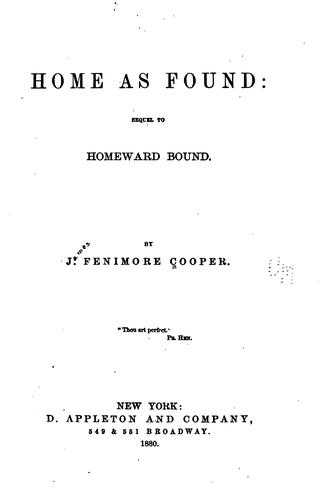
Home as Found: Sequel to "Homeward Bound"Cooper, James Fenimore
General
Home as Found: Sequel to "Homeward Bound"
Cooper, James Fenimore
United States -- Social life and customs -- Fiction
Lest the reader should suppose we are drawing caricatures, instead of
representing an actual condition of society, it may be necessary to
explain that Mr. Bragg was a standing candidate for popular favour;
that, like Mr. Dodge, he considered every thing that presented itself
in the name of the public, as sacred and paramount, and that so
general and positive was his deference for majorities, that it was
the bias of his mind to think half-a-dozen always in the right, as
opposed to one, although that one, agreeably to the great decision of
the real majority of the entire community, had not only the law on
his side, but all the abstract merits of the disputed question. In
short, to such a pass of freedom had Mr. Bragg, in common with a
large class of his countrymen, carried his notions, that he had
really begun to imagine liberty was all means and no end.
Chapter XII.
"In sooth, thou wast in very gracious fooling last night, when thou
spokest of Pigrogromotus, of the Vapians passing the equinoctial of
Queubus; 't was very good i' faith."--SIR ANDREW AGUE-CHEEK.
The progress of society, it has just been said, in what is termed a
"new country," is a little anomalous. At the commencement of a
settlement, there is much of that sort of kind feeling and mutual
interest, which men are apt to manifest towards each other, when they
are embarked in an enterprise of common hazards. The distance that is
unavoidably inseparable from education, habits and manners, is
lessened by mutual wants and mutual efforts; and the gentleman, even
while he may maintain his character and station, maintains them with
that species of good-fellowship and familiarity, that marks the
intercourse between the officer and the soldier, in an arduous
campaign. Men, and even women, break bread together, and otherwise
commingle, that, in different circumstances, would be strangers; the
hardy adventures and rough living of the forest, apparently lowering
the pretensions of the man of cultivation and mere mental resources,
to something very near the level of those of the man of physical
energy, and manual skill. In this rude intercourse, the parties meet,
as it might be, on a sort of neutral ground, one yielding some of his
superiority, and the other laying claims to an outward show of
equality, that he secretly knows, however, is the result of the
peculiar circumstances in which he is placed. In short, the state of
society is favourable to the claims of mere animal force, and
unfavourable to those of the higher qualities.
Public-domain text, read in full here on John Shaqi.
Reviews
Reviews
No reviews yet
Be the first to share your thoughts on this work.
Elsewhere in the archive
Join the Discussion
Join the discussion
Sign in to leave a comment or review.
Sign InorCreate an account