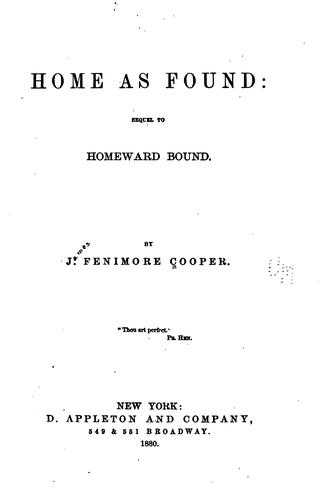
Home as Found: Sequel to "Homeward Bound"Cooper, James Fenimore
General
Home as Found: Sequel to "Homeward Bound"
Cooper, James Fenimore
United States -- Social life and customs -- Fiction
This period may be termed, perhaps, the happiest of the first century
of a settlement. The great cares of life are so engrossing and
serious, that small vexations are overlooked, and the petty
grievances that would make us seriously uncomfortable in a more
regular state of society, are taken as matters of course, or laughed
at as the regular and expected incidents of the day. Good-will
abounds; neighbour comes cheerfully to the aid of neighbour; and life
has much of the reckless gaiety, careless association, and buoyant
merriment of childhood. It is found that they who have passed through
this probation, usually look back to it with regret, and are fond of
dwelling on the rude scenes and ridiculous events that distinguish
the history of a new settlement, as the hunter is known to pine for
the forest.
To this period of fun, toil, neighbourly feeling and adventure,
succeeds another, in which society begins to marshal itself, and the
ordinary passions have sway. Now it is, that we see the struggles for
place, the heart-burnings and jealousies of contending families, and
the influence of mere money. Circumstances have probably established
the local superiority of a few beyond all question, and the
conditioese serves as a goal for the rest to aim at. The learned
professions, the ministry included, or what, by courtesy, are so
called, take precedence, as a matter of course, next to wealth,
however, when wealth is at all supported by appearances. Then
commence those gradations of social station, that set institutions at
defiance, and which as necessarily follow civilization, as tastes and
habits are a consequence of indulgence.
This is, perhaps, the least inviting condition of society that
belongs to any country that can claim to be free and removed from
barbarism. The tastes are too uncultivated to exercise any essential
influence; and when they do exist, it is usually with the pretension
and effort that so commonly accompany infant knowledge. The struggle
is only so much the more severe, in consequence of the late _pèle
mèle_, while men lay claim to a consideration that would seem beyond
their reach, in an older and more regulated community. It is during
this period that manners suffer the most, since they want the nature
and feeling of the first condition, while they are exposed to the
rudest assaults of the coarse-minded and vulgar; for, as men usually
defer to a superiority that is long established, there being a charm
about antiquity that is sometimes able to repress the passions, in
older communities the marshalling of time quietly regulates what is
here the subject of strife.
Public-domain text, read in full here on John Shaqi.
Reviews
Reviews
No reviews yet
Be the first to share your thoughts on this work.
Elsewhere in the archive
Join the Discussion
Join the discussion
Sign in to leave a comment or review.
Sign InorCreate an account