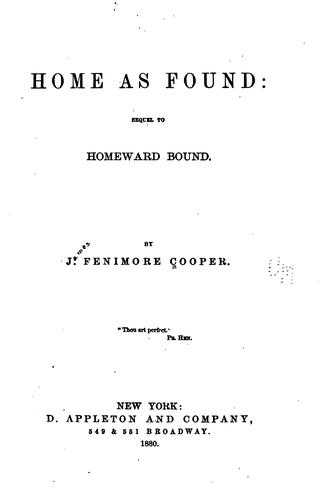
Home as Found: Sequel to "Homeward Bound"Cooper, James Fenimore
General
Home as Found: Sequel to "Homeward Bound"
Cooper, James Fenimore
United States -- Social life and customs -- Fiction
Aristabulus did not read, for he was too much filled with wonder at
seeing a man so coolly set about contending with that awful public
which he himself as habitually deferred to, as any Asiatic slave
defers to his monarch. Indeed, nothing but his being sustained by
that omnipotent power, as he viewed the power of the public to be,
had emboldened him to speak so openly to his employer, for
Aristabulus felt a secret confidence that, right or wrong, it was
always safe in America to make the most fearless professions in
favour of the great body of the community. In the mean time, Mr.
Effingham wrote a simple advertisement, against trespassing on the
property in question, and handed it to the other, with a request that
he would have it inserted in the number of the village paper that was
to appear next morning. Mr. Bragg took the advertisement, and went to
execute the duty without comment.
The evening arrived before Mr. Effingham was again alone, when, being
by himself in the library once more, Mr. Bragg entered, full of his
subject. He was followed by John Effingham, who had gained an inkling
of what had passed.
"I regret to say, Mr. Effingham," Aristabulus commenced, "that your
advertisement has created one of the greatest excitements it has ever
been my ill-fortune to witness in Templeton."
"All of which ought to be very encouraging to us, Mr.. Bragg, as men
under excitement are usually wrong."
"Very true, sir, as regards individual excitement, but this is a
public excitement."
"I am not at all aware that the fact, in the least alters the case.
If one excited man is apt to do silly things, half a dozen backers
will be very likely to increase his folly."
Aristabulus listened with wonder, for excitement was one of the means
for effecting public objects, so much practised by men of his habits,
that it had never crossed his mind any single individual could be
indifferent to its effect. To own the truth, he had anticipated so
much unpopularity, from his unavoidable connexion with the affair, as
to have contributed himself in producing the excitement, with the
hope of "choking Mr. Effingham off," as he had elegantly expressed it
to one of his intimates, in the vernacular of the country.
"A public excitement is a powerful engine, Mr. Effingham!" he
exclaimed, in a sort of politico pious horror.
"I am fully aware, sir, that it may be even a fearfully powerful
engine. Excited men, acting in masses, compose what are called mobs,
and have committed a thousand excesses."
"Your advertisement is, to the last degree, disrelished; to be very
sincere, it is awfully unpopular!"
"I suppose it is always what you term an unpopular act, so far as the
individuals opposed are concerned, to resist aggression."
"But they call your advertisement aggression, sir."
Public-domain text, read in full here on John Shaqi.
Reviews
Reviews
No reviews yet
Be the first to share your thoughts on this work.
Elsewhere in the archive
Join the Discussion
Join the discussion
Sign in to leave a comment or review.
Sign InorCreate an account