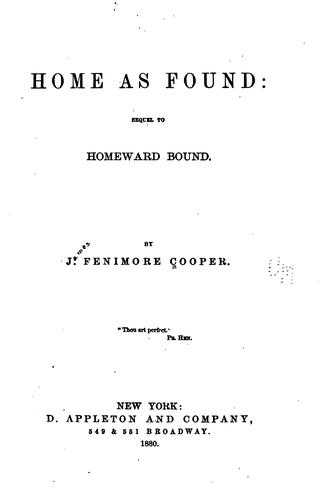
Home as Found: Sequel to "Homeward Bound"Cooper, James Fenimore
General
Home as Found: Sequel to "Homeward Bound"
Cooper, James Fenimore
United States -- Social life and customs -- Fiction
"In that simple fact exist all the merits of the question. If I own
this property, the public, or that portion of it which is connected
with this affair, are aggressors; and so much more in the wrong that
they are many against one; if _they_ own the property, I am not only
wrong, but very indiscreet."
The calmness with which Mr. Effingham spoke had an effect on
Aristabulus, and, for a moment, he was staggered. It was only for a
moment, however, as the pains and penalties of unpopularity presented
themselves afresh to an imagination that had been so long accustomed
to study the popular caprice, that it had got to deem the public
favour the one great good of life.
"But _they_ say, _they_ own the Point, Mr. Effingham."
"And _I_ say, they do _not_ own the Point, Mr. Bragg; never _did_ own
it; and, with my consent, never _shall_ own it."
"This is purely a matter of fact," observed John Effingham, "and I
confess I am curious to know how or whence this potent public derives
its title. You are lawyer enough, Mr. Bragg, to know that the public
can hold property only by use, or by especial statute. Now, under
which title does this claim present itself."
"First, by use, sir, and then by especial gift."
"The use, you are aware, must be adverse, or as opposed to the title
of the other claimants. Now, I am a living witness that my late uncle
_permitted_ the public to use this Point, and that the public
accepted the conditions. Its use, therefore, has not been adverse,
or, at least, not for a time sufficient to make title. Every hour
that my cousin has _permitted_ the public to enjoy his property, adds
to his right, as well as to the obligation conferred on that public,
and increases the duty of the latter to cease intruding, whenever he
desires it. If there is an especial gift, as I understand you to say,
from my late uncle, there must also be a law to enable the public to
hold, or a trustee; which is the fact?"
"I admit, Mr. John Effingham, that I have seen neither deed nor law,
and I doubt if the latter exist. Still the public _must_ have some
claim, for it is impossible that every body should be mistaken."
"Nothing is easier, nor any thing more common, than for whole
communities to be mistaken, and more particularly when they commence
with excitement."
While his cousin was speaking, Mr. Effingham went to a secretary, and
taking out a large bundle of papers, he laid it down on the table,
unfolding several parchment deeds, to which massive seals, bearing
the arms of the late colony, as well as those of England, were
pendent.
"Here are my titles, sir," he said, addressing Aristabulus pointedly;
"if the public has a better, let it be produced, and I shall at once
submit to its claim."
Public-domain text, read in full here on John Shaqi.
Reviews
Reviews
No reviews yet
Be the first to share your thoughts on this work.
Elsewhere in the archive
Join the Discussion
Join the discussion
Sign in to leave a comment or review.
Sign InorCreate an account