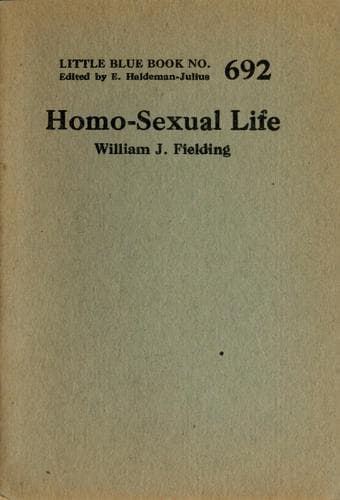
Homo-sexual lifeFielding, William J. (William John)
Science
Homo-sexual life
Fielding, William J. (William John)
Homosexuality; Sex (Psychology)
(c) The partial desires which usually appear in contrasting pairs, play
a very prominent role among the symptom-creators in psychoneuroses.
They are known as carriers of new sexual aims, such as peeping
mania, exhibitionism and the actively and passively formed impulses
of cruelty. The contribution of the last is indispensable for the
understanding of the morbid nature of the symptoms; it almost regularly
controls some portion of the social behavior of the patient. The
transformation of love into hatred, of tenderness into hostility,
which is characteristic of paranoiacs, takes place by means of the union of
cruelty with the libido.
The significance of the erogenous zones in relation to inversion is
important. Moll’s concept, which divides the sexual impulse into the
impulse of contrectation and detumescence, is useful in this field.
(Contrectation signifies a desire to touch the skin; detumescence the
subsidence of the state of physical sexual preparedness.)
“In the perversions, which claim sexual significance for the oral
cavity and the anal opening,” as Freud remarks, “the part played by the
erogenous zone is quite evident. It behaves in every way like a part
of the sexual apparatus. In hysteria, these parts of the body, as well
as the tracts of mucous membrane proceeding from them, become the seat
of new sensations and innervating changes in a manner similar to the
genitals when under the excitement of normal sexual processes.”
HOMO-SEXUAL PANIC.
Dr. Edward J. Kempf refers to the pressure of uncontrollable perverse
cravings as “_acute homosexual panic_,” which is frequently observed
whenever men or women are grouped alone for prolonged periods, as
in army camps, aboard ships, on exploring expeditions, in prisons,
asylums, and schools.
The acute panic of the personality is due to the perverse sexual
cravings which threaten to overcome the ego, and disestablish the
individual’s self-control. At the same time, the affections for winning
social esteem are pushed into an eccentric adjustment. The weakness
of the ego may be attributed to fatigue, debilitating illness, loss
of the love object, homesickness, misfortunes, imposition on the part
of a superior, or erotic companions. As the individual shows his
eccentricities and irritability, he is often teased and tormented
by his fellows. With this there comes a loss of social influence,
which develops a sense of inferiority, or strengthens the feeling of
inferiority that already exists.
The attempt to overcome the fear of inferiority spurs the subject
on to intense compensating efforts which, however, because of their
eccentric character, further increases the antagonism. Thus we have a
vicious circle in the realm of the emotions and affective nature, which
gradually becomes a persecution. The erotic individual, under these
circumstances, as the perverse sexual impulses tend to force him into
further danger, becomes panic-stricken.
Public-domain text, read in full here on John Shaqi.
Reviews
Reviews
No reviews yet
Be the first to share your thoughts on this work.
Join the Discussion
Join the discussion
Sign in to leave a comment or review.
Sign InorCreate an account