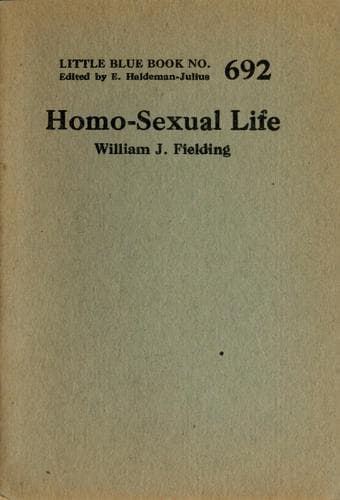
Homo-sexual lifeFielding, William J. (William John)
Science
Homo-sexual life
Fielding, William J. (William John)
Homosexuality; Sex (Psychology)
Naturally, the male Urning is not inclined to fall in love with a
woman, but that they are drawn near to women seems logical as it
is characteristic of similar types to have much in common, such as
sympathetic interests, etc. And, of course, the male Urning and the
normal woman have a great deal in common in the sphere of spiritual and
emotional interests and understanding.
Carpenter states in this connection, “it would seem they often feel
a singular appreciation and understanding of the emotional needs and
destinies of the other sex, leading in many cases to a genuine though
what is called ‘Platonic’ friendship. There is little doubt that they
are often instinctively sought after by women who, without suspecting
the real cause, are conscious of a sympathetic chord in the homogenic
which they miss in the normal man.”
De Joux confirms this in these words: “It would be a mistake to suppose
that all Urnings must be woman haters. Quite the contrary. They are not
seldom their faithfulest friends, the truest allies and most convinced
defenders of women.”
Havelock Ellis in Chapter VI of his “_Sexual Inversion_,” also scouts
the idea that the Uranian temperament is necessarily morbid, and
states that the tendency should be considered an anomaly rather than
a disease. He makes this interesting observation on the subject,
comparing the invert to the “sport” or variation in the animal and
vegetable world: “Thus in sexual inversion we have what may fairly be
called a ‘sport’ or variation, one of those organic aberrations which
we see throughout living nature in plants and in animals.”
And Ellis writes, with reference to the artistic proclivities of the
invert: “An examination of my cases reveals the interesting fact that
thirty-two of them, or sixty-eight per cent, possess artistic aptitude
in varying degrees.
“Galton found, from the investigation of nearly one thousand persons,
that the general average showing artistic taste in England is only
about thirty per cent. It must be said that my figures are probably
below the truth, as no special point was made of investigating the
matter, and also that in many cases their artistic aptitudes are of
high order. With regard to the special avocations of my cases, it must,
of course, be said that no occupation furnishes a safeguard against
inversion. There are, however, certain occupations to which inverts are
specially attracted. Acting is certainly one of the chief of these.
Three of my cases belong to the dramatic profession, and others have
marked dramatic ability. Art, again, in its various forms, and music,
exercise much attraction. In my experience, however, literature is
the avocation to which inverts seem to feel chiefly called, and that
moreover in which they may find the highest degrees of success and
reputation. At least half a dozen of my cases are successful men of
letters.”
Public-domain text, read in full here on John Shaqi.
Reviews
Reviews
No reviews yet
Be the first to share your thoughts on this work.
Join the Discussion
Join the discussion
Sign in to leave a comment or review.
Sign InorCreate an account