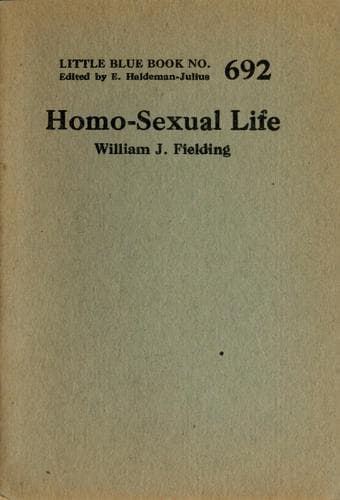
Homo-sexual lifeFielding, William J. (William John)
Science
Homo-sexual life
Fielding, William J. (William John)
Homosexuality; Sex (Psychology)
2. A comprehensive theory of homosexuality must also explain the
extreme cases, particularly male homosexuality coupled with complete
virility.
3. Sexual parts and genital glands cannot determine homosexuality
in those possessing typical normal male genitalia and testicles;
neither can the brain itself be the determining factor in genuine
homosexuality, because homosexuality cannot be rooted out by the
strongest conscious and unconscious heterosexual influences brought to
bear upon thought and phantasy,--the condition developing in spite of
such influences.
4. Since as a predisposition (not as sexual instinct) homosexuality
appears long before puberty and before the actual functioning of
the respective genital glands, it suggests that in homosexuals some
physiologic action pertaining to “sexuality,” but not necessarily
related to the functioning of the genital glands, undergoes some subtle
change as the result of which the sexual instinct is turned from its
goal.
5. The condition suggests chemical changes, alteration in the chemistry
of sexual tension, the latter being fairly independent of the activity
of the sexual glands proper, as is shown by the fact that it may be
preserved among eunuchs and others who undergo castration.
Krafft-Ebing, Hirschfeld and Bloch, as well as many other investigators
and writers, have failed to appreciate the psychological factors
involved in homosexuality. Every young individual unconsciously
patterns its conduct, especially in the matter of its attitudes toward
persons of the opposite sex, after some one in the home environment.
When the boy, for instance, is raised under conditions which cause
him to pattern his actions after the mother-model, to _feel_ himself
woman-like, he will unconsciously and automatically imitate feminine
ways and adopt woman’s attitudes, in the sexual sphere as well as
otherwise.
To illustrate this point, if a boy is brought up by a widowed mother,
let us say, in a home environment in which there is no male present,
the young boy, impelled to imitate some one in order to establish
a standard of conduct, copies his mother’s attitude of physical
indifference to women and physical interest in men (if she is a
normally constituted woman). If the mother, or other feminine guardian,
should be homosexually disposed, i.e., showing a physical interest in
women and a physical indifference to men, then, by the same token, the
boy would tend to develop a sexual interest in women, and become a
normal heterosexual man.
Every young boy’s ambition, normally, is to be like his father;
later, it may be to excel the father--but this identification, under
the circumstances, is present. Now, the absence of a father in the
house, or the presence of a father of weak character, who suffers
in comparison with the mother, tends to force the youth to make his
ego-ideal identification with the mother, with results that are not
conducive to normality in the sexual life.
Public-domain text, read in full here on John Shaqi.
Reviews
Reviews
No reviews yet
Be the first to share your thoughts on this work.
Join the Discussion
Join the discussion
Sign in to leave a comment or review.
Sign InorCreate an account