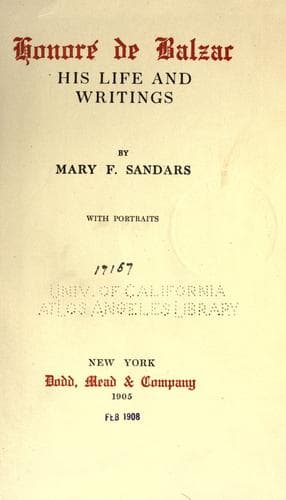
Honore de Balzac, His Life and WritingsSandars, Mary Frances
General
Honore de Balzac, His Life and Writings
Sandars, Mary Frances
Balzac, Honoré de, 1799-1850; Novelists, French -- 19th century -- Biography
Balzac was not orthodox. There is no doubt, from a letter to Madame
Hanska, that the Swedenborgian creed he enunciates in "Seraphita" is
to a great extent his own; but he believed in God, in the immortality
of the soul, and considered natural religion, of which, in his eyes,
the Bourbons were the depositors, absolutely essential to the
well-being of a State. He had a great respect for the priesthood, and
has left many a charming and sympathetic picture of the parish _cure_,
such as l'Abbe Janvier in "Le Medecin de Campagne," who acts hand in
hand with the good doctor Benassis, as an enlightened benefactor to
the poor; or l'Abbe Bonnet, the hero of "Le Cure du Village," whose
face had "the impress of faith, an impress giving the stamp of the
human greatness which approaches most nearly to divine greatness, and
of which the undefinable expression beautifies the most ordinary
features." In "Les Paysans" we have another fine portrait, L'Abbe
Brossette, who is doing his work nobly among debased and cunning
peasants. "To serve was his motto, to serve the Church and the
Monarchy at the most menaced points; to serve in the last rank, like a
soldier who feels destined sooner or later to rise to generalship, by
his desire to do well, and by his courage."
There is a beautiful touch in that terrible book "La Cousine Bette,"
where the infamous Madame Marneffe is dying of a loathsome and
infectious disease, so that even Bette, who feels for her the
"strongest sentiment known, the affection of a woman for a woman, had
not the heroic constancy of the Church," and could not enter the room.
Religion alone, in the guise of a Sister of Mercy, watched over her.
CHAPTER X
1836
Balzac starts the _Chronique de Paris_--Balzac and Theophile
Gautier--Lawsuit with the _Revue de Paris_--Failure of the
_Chronique_--Strain and exhaustion--Balzac travels in Italy
--Madame Marbouty--Return to Paris--Death of Madame de Berny
--Balzac's grief and family anxieties--He is imprisoned for
refusal to serve in Garde Nationale--Werdet's failure--Balzac's
desperate pecuniary position and prodigies of work--Close of
the disastrous year 1836.
Public-domain text, read in full here on John Shaqi.
Reviews
Reviews
No reviews yet
Be the first to share your thoughts on this work.
Elsewhere in the archive
Join the Discussion
Join the discussion
Sign in to leave a comment or review.
Sign InorCreate an account