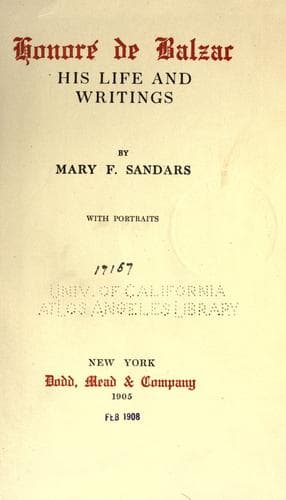
Honore de Balzac, His Life and WritingsSandars, Mary Frances
General
Honore de Balzac, His Life and Writings
Sandars, Mary Frances
Balzac, Honoré de, 1799-1850; Novelists, French -- 19th century -- Biography
Balzac opened the first day of the year 1836 by becoming proprietor of
the _Chronique de Paris_, an obscure Legitimist publication, which had
been founded in 1834 by M. William Duckett. It started under Balzac's
management with a great flourish of trumpets, the Comte (afterwards
Marquis) de Belloy and the Comte de Gramont taking posts as his
sectaries; while Jules Sandeau, Emile Regnault, Gustave Planche,
Theophile Gautier, Charles de Bernard, and others, became his
collaborators. Balzac's special work was to provide a series of papers
on political questions, entitled "La France et l'Etranger," papers
which show his extraordinary versatility; and his helpers were to
provide novels and poems, satire, drama, and social criticism; so that
the scope of the periodical was a wide one.
At first, Balzac was most sanguine about the success of his new
enterprise, and was very active and enthusiastic in working for it. On
March 27th, he wrote to Madame Hanska about the embarrassment caused
him by his plate having been pawned during his unfortunate absence in
Vienna, nearly a year ago. It was worth five or six thousand francs,
and he required three thousand to redeem it. This sum he had never
been able to raise, while, to add to his difficulties, on the 31st of
the month he would owe about eight thousand four hundred francs.
Nevertheless, he _must_ have the silver next day or perish, as he had
asked some people to dine who would, he hoped, give sixteen thousand
francs for sixteen shares in the _Chronique_. If borrowed plate were
on his table he was terribly afraid that the whole transaction would
fail; as one of the people invited was a painter, and painters are an
"observant, malicious, profound race, who take in everything at a
glance."[*] Everything else in his rooms would represent the opulence,
ease, and wealth of the happy artist.
[*] "Lettres a l'Etrangere."
Poor Balzac! To add to his difficulties, it was impossible to borrow
anywhere in Paris, as he had only purchased the _Chronique_ through
the exceptional credit he enjoyed, and this would be at once destroyed
if he were known to be in difficulties. We do not hear any further
particulars about this tragedy, and cannot tell how far the
conjunction of the borrowed plate--if it _were_ after all borrowed
--and the astute painter, contributed to the downfall of the
_Chronique_. Werdet, however, attributes the disaster to the laziness
of the talented staff, who could not be induced to work together.
However that may be, the result was a terrible blow to Balzac; who was
now, in addition to all his other liabilities, in debt for forty
thousand francs to the shareholders.
Public-domain text, read in full here on John Shaqi.
Reviews
Reviews
No reviews yet
Be the first to share your thoughts on this work.
Elsewhere in the archive
Join the Discussion
Join the discussion
Sign in to leave a comment or review.
Sign InorCreate an account