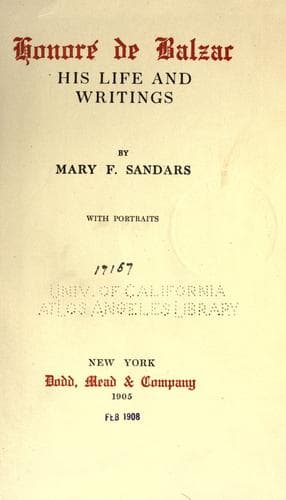
Honore de Balzac, His Life and WritingsSandars, Mary Frances
General
Honore de Balzac, His Life and Writings
Sandars, Mary Frances
Balzac, Honoré de, 1799-1850; Novelists, French -- 19th century -- Biography
In the midst of his trouble, a most unfortunate occurrence took place,
which besides embittering his life at the time had a decided effect on
his subsequent career; and indirectly obscured his reputation even
after his death.
In 1833, as we have already seen, Balzac, after long dissensions with
Amedee Pichot, had definitely left the _Revue de Paris_. However, in
1834, when Pichot retired from the management, the new directors, MM.
Anthoine de Saint-Joseph, Bonnaire, and Achille Brindeau, tried to
satisfy their readers by recalling Balzac; and "Seraphita" began to
appear in the pages of the _Revue_. Difficulties, as might be
expected, soon arose between Balzac and the management; and the
undercurrent of irritation which subsisted on both sides only required
some slight extra cause of offence, to render an outbreak inevitable.
In September, 1835, M. Buloz, already director of the _Revue des Deux
Mondes_, an extremely able, but bad-mannered and dictatorial man, took
possession also of the much-tossed-about _Revue de Paris_. Balzac had
known Buloz since 1831, when the latter bought the _Revue des Deux
Mondes_, which was then in very low water, and was working with
tremendous energy to make it successful. At that time, Buloz and he
often shared a modest dinner, and with the permission of M. Rabou,
then manager of the _Revue de Paris_, Balzac contributed "L'Enfant
Maudit," "Le Message," and "Le Rendez-Vous" to the _Revue des Deux
Mondes_, and only charged a hundred francs for the same quantity of
pages for which he was paid a hundred and sixty francs by Rabou.
However, on April 15th, 1832, there appeared in the _Revue des Deux
Mondes_ a scathing, anonymous criticism of the first dizain of the
"Contes Drolatiques." This had apparently been written by Gustave
Planche; but Balzac considered Buloz responsible for it, and therefore
refused to write any longer for his review. In August, 1832, Buloz,
who does not appear to have been particularly scrupulous in his
business relations, wrote to apologise, saying that though it was not
in his power to suppress the offending article, he had done his best
to soften it; and that now he was sole master of the Revue, so that
not a word or line could pass without his permission. He therefore
begged Balzac to resume his old connection with him, and explained
that if he had not been confined to his bed and unable to walk, or
even to bear the shaking of a cab, he would have come to visit him,
and matters would have been quickly arranged. Balzac's answer, which
is written from Angouleme, is couched in the uncompromising terms of
"no surrender," which he generally adopted when he considered himself
aggrieved. He did not absolutely refuse to write for the Review, and
referred Buloz to Madame de Balzac for terms; but, by the tone of his
letter, he negatived decidedly the idea of resuming friendly relations
with his correspondent, and while rather illogically professing a
Public-domain text, read in full here on John Shaqi.
Reviews
Reviews
No reviews yet
Be the first to share your thoughts on this work.
Elsewhere in the archive
Join the Discussion
Join the discussion
Sign in to leave a comment or review.
Sign InorCreate an account