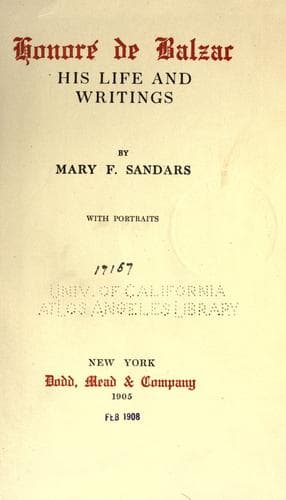
Honore de Balzac, His Life and WritingsSandars, Mary Frances
General
Honore de Balzac, His Life and Writings
Sandars, Mary Frances
Balzac, Honoré de, 1799-1850; Novelists, French -- 19th century -- Biography
It is as a member of the staff of the _Chronique_, that the name of
Theophile Gautier first appears in connection with Balzac; and the two
men remained close friends till Balzac's death. In 1835 Theophile
Gautier published "Mademoiselle de Maupin," in which his incomparable
style excited Balzac's intense admiration, painfully conscious as he
was of his own deficiencies in this direction. Therefore, in forming
the staff of the _Chronique_, he at once thought of Gautier, and
despatched Jules Sandeau to arrange matters with the young author, and
to give him an invitation to breakfast. Theophile Gautier, much
flattered, but at the same time rather alarmed at the idea of an
interview with the celebrated Balzac, tells us that he thought over
various brilliant discourses on his way to the Rue Cassini, but was so
nervous when he arrived that all his preparations came to nothing, and
he merely remarked on the fineness of the weather. However, Balzac
soon put him at his ease, and evidently took a fancy to him at once,
as during breakfast he let him into the secret that for this solemn
occasion he had borrowed silver dishes from his publisher!
The friendship between Balzac and Gautier, though not as intimate and
confidential as that between Balzac and Borget, was true and
steadfast; and was never disturbed by literary jealousy. Gautier
supported Balzac's plays in _La Presse_, and helped with many of his
writings. Traces of his workmanship, M. de Spoelberch de Lovenjoul
tells us, are specially noticeable in the descriptions of the art of
painting and of the studio, in the edition of "Un Chef-d'Oeuvre
Inconnu" which appeared in 1837.[*] These descriptions are in
Gautier's manner, and do not appear in the edition of 1831; so that in
all probability they were written, or at any rate inspired by him.
Gautier also wrote for Balzac, who had absolutely no faculty for
verse, the supposed translation of two Spanish sonnets in the
"Memoires de Deux Jeunes Mariees," and the sonnet called "La Tulipe"
in "Un Grand Homme de Province a Paris." On his side, Balzac defended
Gautier on all occasions, and in 1839 dedicated "Les Secrets de la
Princesse de Cadignan," then called "Un Princesse Parisienne," "A
Theophile Gautier, son ami, H. de Balzac."
[*] "H. de Balzac and Theophile Gautier" in "Autour de Honore de
Balzac," by the Vicomte de Spoelberch de Lovenjoul.
Beyond this friendship, the affair of the _Chronique_ brought Balzac
nothing but worry and trouble. And it came at a time when misfortune
assailed him on all sides. Madame de Berny was approaching her end,
and he wrote to his mother on January 1st, 1836, the day he started
the _Chronique de Paris_: "Ah! my poor mother, I am broken-hearted.
Madame de Berny is dying! It is impossible to doubt it! Only God and I
know what is my despair. And I must work! Work weeping."[*]
[*] "Correspondance," vol. i. p. 323.
Public-domain text, read in full here on John Shaqi.
Reviews
Reviews
No reviews yet
Be the first to share your thoughts on this work.
Elsewhere in the archive
Join the Discussion
Join the discussion
Sign in to leave a comment or review.
Sign InorCreate an account