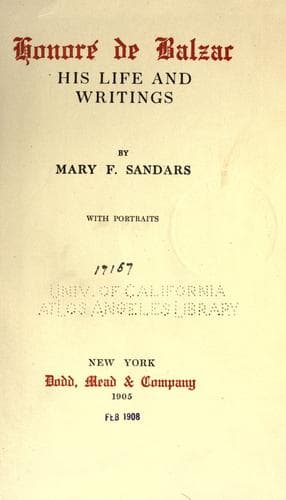
Honore de Balzac, His Life and WritingsSandars, Mary Frances
General
Honore de Balzac, His Life and Writings
Sandars, Mary Frances
Balzac, Honoré de, 1799-1850; Novelists, French -- 19th century -- Biography
It is amusing to discover that Balzac did not take this journey alone.
He was accompanied by a lady whom he describes in a letter as
"charming, _spirituelle_, and virtuous," and who, never having had the
chance in her life of breathing the air of Italy, and being able to
steal twenty days from the fatigues of housekeeping, had trusted in
him for inviolable secrecy and "scipionesque" behaviour. "She knows
whom I love, and finds there the strongest safeguard."[*] This lady
was Madame Marbouty, known in literature as Claire Brunne, and during
her stay in Italy as "Marcel"--a name taken from the devoted servant
in Meyerbeer's opera "Les Huguenots," which had just appeared. A few
weeks earlier, she had refused to travel in Touraine with Balzac, as
she considered that a journey with him in France would compromise her;
but, apparently, in Italy this objection did not apply. She travelled
in man's clothes, as Balzac's page, and both he and she were
childishly delighted by the mystification they caused. Comte Sclopis,
the celebrated Piedmontese statesman, who acted as their cicerone in
Turin society, was much fascinated by the charming page. The liking
was evidently mutual, as, after the travellers had left Italy, Balzac
records that at Vevey, Lausanne, and all the places they visited,
Marcel cried: "And no Sclopis!" and it sounds as though the
exclamation had been accompanied by a sigh. Several times during the
journey the lively Amazon was mistaken for George Sand, whom she
resembled in face, as well as in the fancy for donning masculine
attire; and the mistake caused her intense satisfaction. At Geneva,
haunted to Balzac by happy memories, the travellers stayed at the
Hotel de l'Arc, and Balzac's mind was full of his lady-love, whose
spirit seemed to him to hallow the place. He saw the house where she
stayed, went along the road where they had walked together, and was
refreshed in the midst of his troubles and anxieties by the thought of
her.
[*] See "L'Ecole des Manages," in "Autour de Honore de Balzac," by the
Vicomte de Spoelberch de Lovenjoul.
On August 22nd the travellers returned to Paris on excellent terms
with each other, and for some years after this journey friendly
relations continued. In 1842, in remembrance of their adventure,
Balzac dedicated "La Grenadiere" to Madame Marbouty, under the name of
Caroline, and added the words, "A la poesie du voyage, le voyageur
reconnaissant." Later on, however, they quarrelled, and she wrote "Une
Fausse Position," in which Balzac is represented in a decidedly
unflattering light; and after this he naturally withdrew the
dedication in "La Grenadiere."
Public-domain text, read in full here on John Shaqi.
Reviews
Reviews
No reviews yet
Be the first to share your thoughts on this work.
Elsewhere in the archive
Join the Discussion
Join the discussion
Sign in to leave a comment or review.
Sign InorCreate an account