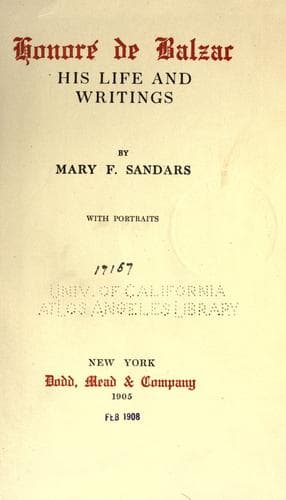
Honore de Balzac, His Life and WritingsSandars, Mary Frances
General
Honore de Balzac, His Life and Writings
Sandars, Mary Frances
Balzac, Honoré de, 1799-1850; Novelists, French -- 19th century -- Biography
On his return from this amusing trip a terrible trouble awaited
Balzac. Among the letters heaped together upon his writing-table was
one from Alexandre de Berny, announcing abruptly the death of Madame
de Berny, which had taken place on July 27th. Balzac was utterly
crushed by this blow. He had not seen Madame de Berny for some time,
as since the death of her favourite son she had shut herself up
completely, pretending to Balzac that she was not very ill, but saying
laughingly that she only wanted to see him when she was beautiful and
in good health. Now she was dead, and the news came without
preparation in the midst of his other troubles. She was half his life,
he cried in despair; and writing to Madame Hanska he said that his
sorrow had almost killed him. In the midst of this overwhelming grief
other worries added their quota to the weight oppressing Balzac. Henri
de Balzac gave his family continual trouble, while Laurence's husband,
M. de Montzaigle, refused to support his children; in fact, the only
faint relief to the darkness surrounding the Balzac family at this
time was M. Surville's hopefulness about the Loire Canal scheme.
In addition to all these misfortunes, Balzac had to submit to the
annoyance of several days' imprisonment in the Hotel des Haricots, for
his refusal to serve in the Garde Nationale, a duty which was, he
said, the nightmare of his life. The place of detention was not
luxurious. There was no fire, and he was in the same hall for a time
with a number of workmen, who made a terrible noise. Fortunately, he
was soon moved to a private room, where he was warm and could work in
peace. After this, in terrible pecuniary difficulties, and feeling
acutely the loss of the woman who had been an angel to him in his
former troubles, he left the Rue Cassini and fled from Paris, to avoid
further detention by the civic authorities. He took refuge at
Chaillot, and under the name of Madame Veuve Durand hid at No. 13, Rue
des Batailles. Here he lodged for a time in a garret formerly occupied
by Jules Sandeau, from the window of which there was a magnificent
view of Paris, from the Ecole Militaire to the barrier of the Trone,
and from the Pantheon to L'Etoile. From time to time Balzac would
pause in his work to gaze on the ocean of houses below; but he never
went out, for he was pursued by his creditors.
Public-domain text, read in full here on John Shaqi.
Reviews
Reviews
No reviews yet
Be the first to share your thoughts on this work.
Elsewhere in the archive
Join the Discussion
Join the discussion
Sign in to leave a comment or review.
Sign InorCreate an account