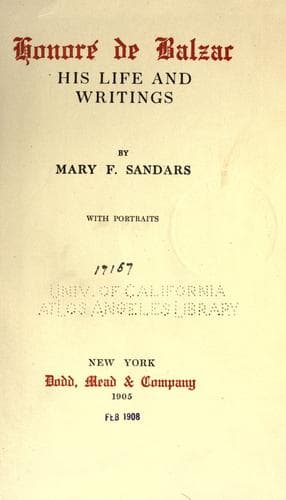
Honore de Balzac, His Life and WritingsSandars, Mary Frances
General
Honore de Balzac, His Life and Writings
Sandars, Mary Frances
Balzac, Honoré de, 1799-1850; Novelists, French -- 19th century -- Biography
The year 1844 was not an unhappy one with Balzac, though his health
was bad, and he speaks of terrible neuralgia; so that he wrote "Les
Paysans" with his head in opium, as he had written "Cesar Birotteau"
with his feet in mustard. Apparently Madame Hanska held out hopes that
in 1845 his long probation might come to and end, as he writes: "Days
of illness are days of pleasure to me, for when I do not work with
absorption of all my moral and physical qualities, I never cease
thinking of 1845. I arrange houses, I furnish them, I see myself
there, and I am happy."[*] It was a joy to him to fulfil Madame
Hanska's commissions, and thus to come in contact with people who had
been at any time connected with her. Therefore, in spite of his busy
life, he took much trouble over the arrangements for the entrance of
Anna's former governess, Mlle Henriette Borel, into a religious house
in Paris, and was present at her reception into the Couvent de la
Visitation, Rue l'Enfer, in December, 1845. He was rather annoyed on
this occasion, as he was working tremendously hard at the "Comedie
Humaine," and at his "Petites Miseres de la Vie Conjugale," and the
good nuns, who "thought the world turned only for themselves," told
him that the ceremony would take place at one o'clock and would last
an hour, whereas it was not over till four, and as he had to see
Lirette afterwards, he could not get away till half-past five.
However, he was consoled by the idea that he was representing his dear
Countess and Anna, who were in Italy at the time, and he thought the
service imposing and very dramatic. He was specially thrilled when the
three new nuns threw themselves on the ground, were covered with a
pall, while prayers for the dead were recited over them; and after
this rose up crowned with white roses, as the brides of Christ.
Lirette was radiant when she had taken the veil, and wished that every
one would enter a religious house.
[*] "Correspondance," vol. ii. p. 102.
In July, 1844, Madame Hanska and her daughter made the acquaintance
of the Comte Georges Mniszech, who appeared to be a very suitable
_parti_for Anna. Balzac naturally took a keen interest in all the
prospective arrangements, and consulted anxiously with Madame Hanska
about the young Comte's character, which must of course have proved
perfect, before a treasure like the young Countess could be confided
to his keeping. It is strikingly characteristic of Balzac's
disinterestedness, that though he knew that the young Countess's
marriage would remove the principal obstacle between him and Madame
Hanska, he was most insistent in recommending caution till the young man
had been for some time on probation. However, an engagement soon took
place, and it seemed as though the great desire of Balzac's heart would
in a short time be within his reach, and that happiness would shine upon
him at last.
Public-domain text, read in full here on John Shaqi.
Reviews
Reviews
No reviews yet
Be the first to share your thoughts on this work.
Elsewhere in the archive
Join the Discussion
Join the discussion
Sign in to leave a comment or review.
Sign InorCreate an account