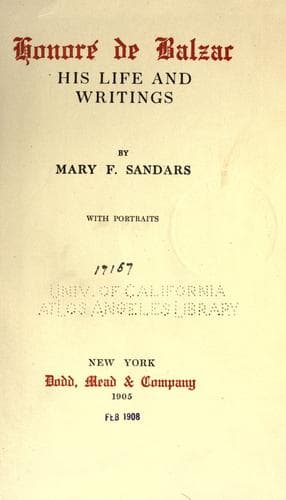
Honore de Balzac, His Life and WritingsSandars, Mary Frances
General
Honore de Balzac, His Life and Writings
Sandars, Mary Frances
Balzac, Honoré de, 1799-1850; Novelists, French -- 19th century -- Biography
In 1844 he published among other books "Modeste Mignon," "Gaudissart
II," a fragment of the first part of "L'Envers de L'Histoire
Contemporaine," which he entitled "Madame de la Chanterie," the end of
the first part of "Splendeurs et Miseres des Courtisanes," the third
and last part of "Beatrix," and the first part of "Les Paysans." This
began to appear in _La Presse_ on December 3rd, and the disputes about
its publication led to Balzac's final rupture with Emile de Girardin.
"Les Paysans" was never finished; but was intended to be the most
considerable, as it is, even in its present fragmentary condition, one
of the most remarkable of Balzac's novels. For eight years he had at
intervals started on the composition of this vivid picture of the deep
under-current of struggle which was going on between the peasant of
France and the _bourgeoisie_; that deadly fight for the possession of
the soil which resulted, as the great _voyant_ plainly descried it
must, in the Revolution of 1848, and the victory of the peasant.
Balzac also intended to depict the demoralisation of the people by
their abandonment of the Catholic religion; and the novel, in
emulation of Victor Hugo and of Dumas, was to fill many volumes. The
first version of it, entitled "Le Grand Proprietaire," was begun about
1835, and the Vicomte de Spoelberch de Lovenjoul in his interesting
book entitled "La Genese d'un Roman de Balzac," gives the text of
this, the MS. of which forms part of his collection. About the year
1836 or 1838, Balzac altered the title of his proposed novel to "Qui a
Terre, a Guerre," and it was not till 1839 that he named the work "Les
Paysans." In 1840 Balzac offered "Les Paysans," which he said was
ready to appear in fifteen days, to M. Dujarier, the manager of _La
Presse_, and received 1,650 francs in advance for the novel. However,
in 1841 he substituted "Les Deux Freres," which was the first part of
"La Rabouilleuse," for "Les Paysans," and offered the latter work as
if finished to Le Messager and also to the publisher Locquin, under
the title of "La Chaumiere et le Chateau."
Public-domain text, read in full here on John Shaqi.
Reviews
Reviews
No reviews yet
Be the first to share your thoughts on this work.
Elsewhere in the archive
Join the Discussion
Join the discussion
Sign in to leave a comment or review.
Sign InorCreate an account