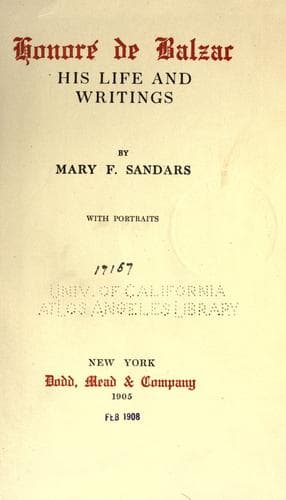
Honore de Balzac, His Life and WritingsSandars, Mary Frances
General
Honore de Balzac, His Life and Writings
Sandars, Mary Frances
Balzac, Honoré de, 1799-1850; Novelists, French -- 19th century -- Biography
After all, the year 1846 ended for him with agitation which
increased his heart disease. His beloved trio, whom he had christened
the "troupe Bilboquet," after the vaudeville "Les Saltimbanques," had
now moved to Wiesbaden; and thither their faithful "Bilboquet," the
"vetturino per amore," as Madame de Girardin laughingly called him,
rushed to meet them. He found "notre grande et chere Atala" rather
crippled with rheumatism, and not able to take the exercise which
was necessary for her, but in his eyes as beautiful as ever. The
"gentille Zephirine," otherwise the Countess Anna, was gay,
charming, and beautifully dressed; and "Gringalet," the Count,
was completely occupied--when not making love--with his collection
of insects, on which he spent large sums. About this collection
Balzac made many rather heavy jokes, calling the Count a
"Gringalet sphynx-lepidoptere-coleoptere-ante-diluvien,"[*] but in
an anxious desire to ingratiate himself with Madame Hanska's family,
he often despatched magnificent specimens of the insect species from
Paris to add to it.
[*] "Correspondance," vol. ii. p. 287.
Balzac travelled about a little with the Hanski family, and remained
with them till September 15th, when he was obliged to go back to
Paris. Either at this time, or when he returned for the wedding of the
Comtesse Anna and the Comte Georges Mniszech, which took place at
Wiesbaden on October 13th, 1846, a secret engagement was contracted
between him and Madame Hanska.
He was now terribly anxious that there should be no further delay
about his marriage, and on his way back from Germany on one of these
two occasions, he applied to M. Germeau, then prefect of Metz,[*] who
had been at school with him at Vendome, to know whether the necessary
formalities could be abridged, so that the wedding might take place at
once. This was impossible; and though the great obstacle to their
union was now removed, Madame Hanska refused to be parted from her
beloved daughter, and insisted on accompanying the newly married
couple on their honeymoon. Her determination caused Balzac terrible
agony of mind, as she was unwell, and was suffering a great deal at
the time, and he therefore wished her to remain quietly somewhere in
France; moreover, despair seized him at her hesitation to become his
wife, when the course at last seemed clear. His trouble at this time
appears to have had a serious effect on his health, and some words
spoken half in malice, half in warning by Madame de Girardin, must
have sounded like a knell in his ears. He tells them apparently in
jest to Madame Hanska to give her an example of the nonsense people
talk in Paris. In his accuracy of repetition, however, we can trace a
passionately anxious desire to force Madame Hanska herself to deny the
charges brought against her; and perhaps lurking behind this, a wish
unacknowledged even to himself, to shame her if--even after all that
had passed--she were really not in earnest.
Public-domain text, read in full here on John Shaqi.
Reviews
Reviews
No reviews yet
Be the first to share your thoughts on this work.
Elsewhere in the archive
Join the Discussion
Join the discussion
Sign in to leave a comment or review.
Sign InorCreate an account