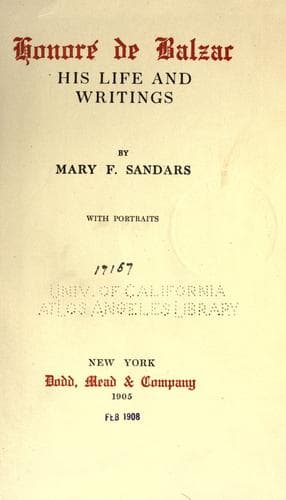
Honore de Balzac, His Life and WritingsSandars, Mary Frances
General
Honore de Balzac, His Life and Writings
Sandars, Mary Frances
Balzac, Honoré de, 1799-1850; Novelists, French -- 19th century -- Biography
[*] See "Une Page Perdue de Honore de Balzac," p. 276, by the Vicomte
de Spoelberch de Lovenjoul.
He says: "Madame de Girardin told me that she heard from a person who
knew you intimately, that you were extremely flattered by my homage;
that from vanity and pride you made me come wherever you went; that
you were very happy to have a man of genius as courier, but that your
social position was too high to allow me to aspire to anything else.
And then she began to laugh with an ironical laugh, and told me that I
was wasting my time running after great ladies, only to fail with
them. Hein! Isn't that like Paris!"[*]
[*] "Correspondance," vol. ii. p. 295.
The reader of Balzac's life is forced to the sad conclusion that
Parisian gossip had on this occasion sketched the situation tolerably
correctly; though the truth of the picture was no doubt denied with
much indignation by Madame Hanska.
CHAPTER XIV
1846 - 1848
Balzac buys a house in the Rue Fortunee--Madame Hanska's visit to
Paris--Balzac burns her letters--Final breach with Emile de
Girardin--Balzac's projects for writing for the theatre--He goes
to Wierzchownia--Plan for transporting oaks from Russia to France
--Balzac returns to Paris at the eve of the Revolution of 1848
--Views on politics--Stands for last time as deputy.
Much of Balzac's time, whenever he was in Paris in 1845 and 1846, was
taken up with house-hunting; and some of his still unpublished letters
to Madame Hanska contain long accounts of the advantages of the
different abodes he had visited. He was now most anxious to be
permanently settled, as there was no room for his art treasures in the
Rue Basse; but as Madame Hanska's tastes had to be consulted as well
as his own, it was necessary to be very careful in his choice.
However, in October, 1846, he at last found something which he thought
would be suitable. This was the villa which had formerly belonged to
the financier Beaujon, in the Rue Fortunee, now the Rue Balzac. The
house was not large, it was what might now be described as a "bijou
residence," but though out of repair, it had been decorated with the
utmost magnificence by Beaujon, and Balzac's discriminating eye
quickly discerned its aesthetic possibilities.
Public-domain text, read in full here on John Shaqi.
Reviews
Reviews
No reviews yet
Be the first to share your thoughts on this work.
Elsewhere in the archive
Join the Discussion
Join the discussion
Sign in to leave a comment or review.
Sign InorCreate an account