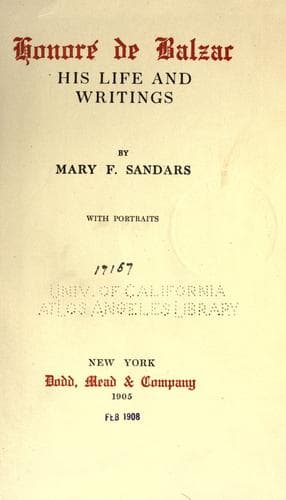
Honore de Balzac, His Life and WritingsSandars, Mary Frances
General
Honore de Balzac, His Life and Writings
Sandars, Mary Frances
Balzac, Honoré de, 1799-1850; Novelists, French -- 19th century -- Biography
The deep thinker, the pessimistic believer in the omnipotence of vice
and in the helpless suffering of virtue, who drags to light what is
horrible from among the dregs of the people, seems to have nothing in
common with the charming, playful figure of "le vieux Bilboquet," who
gave Madame Hanska's daughter and her son-in-law a big place in his
heart, and was never jealous when, avowedly for their sakes, his
wishes, feelings, and health were unconsidered; whose servants,
hard-worked though they were, adored him; and who never forgot his
friends, or failed to help them when adversity fell upon them.
At the beginning of 1847, peace for a time visited Balzac's restless
spirit. In February he went to Germany to fetch Madame Hanska, and
leaving the Mniszechs to go back alone to Wierzchownia, she travelled
with him to Paris, and remained there till April. It is significant,
as the Vicomte de Spoelberch de Lovenjoul remarks,[*] that during the
time of her stay in Paris, when Balzac's mind was no longer disturbed
by his constant longing to see her, he accomplished the last serious
bout of work in his life, beginning the "Depute D'Arcis" in _L'Union_,
"La Cousine Bette" in the _Constitutionnel_, and "La Derniere
Incarnation de Vautrin" in _La Presse_.
[*] "La Genese d'un Roman de Balzac," p. 194
He had other duties at the same time, being occupied with what _he_
calls the most beautiful work of his life, that of preventing "a
mother separated from so adorable a child as her Grace the Countess
Georges, from dying of grief." He writes to the Mniszechs on February
27th, 1847[*]: "Our dear adored Atala is in a charming and magnificent
apartment (and not too dear). She has a garden; she goes a great deal
to the convent" (to see Mlle. Henriette Borel). "I try to distract her
and to be as much as possible Anna to her; but the name of her dear
daughter is so daily and continually on her lips, that the day before
yesterday, when she was enjoying herself immensely at the Varietes--in
fits of laughter at the 'Filleul de Tout le Monde,' acted by Bouffe
and Hyacinthe--in the midst of her gaiety, she asked herself in a
heartbroken voice, which brought tears to my eyes, how she could laugh
and amuse herself like this, without her 'dear little one.' I allow,
dear Zephirine, that I took the liberty of telling her, that you were
amusing yourself enormously without her, with your lord and master,
His Majesty the King of the Coleoptera; that I was sure that you were
at this time one of the happiest women in the world; and I hope that
Gringalet, on whom I drew this bill of exchange, will not contradict
me. I have four tolerably strong attractions to bring forward against
the thought of you: 1st, the Conservatoire; 2nd, the Opera; 3rd, the
Italian Opera; 4th, the Exhibition."
[*] "Correspondance," vol. ii. p. 312.
Public-domain text, read in full here on John Shaqi.
Reviews
Reviews
No reviews yet
Be the first to share your thoughts on this work.
Elsewhere in the archive
Join the Discussion
Join the discussion
Sign in to leave a comment or review.
Sign InorCreate an account