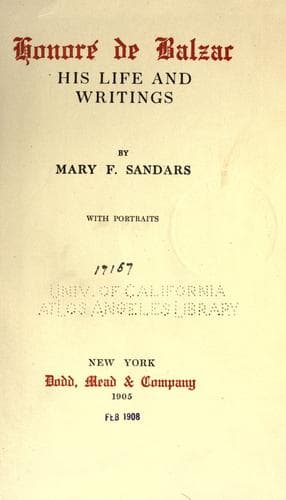
Honore de Balzac, His Life and WritingsSandars, Mary Frances
General
Honore de Balzac, His Life and Writings
Sandars, Mary Frances
Balzac, Honoré de, 1799-1850; Novelists, French -- 19th century -- Biography
Balzac's hands were certainly pleasantly full at this time. His power
of writing, which had temporarily deserted him, seemed now to have
returned in full vigour; and he had made forty or fifty thousand
francs in three months, so was hopeful of paying off his debts, a
point on which Madame Hanska wisely laid much stress. She still
refused to decide anything definitely about the date of their
marriage; but the house was to a great extent her property, and at
this time she identified herself completely with Balzac in all the
arrangements to do with it. Though he kept on his rooms in the Rue
Basse and left his effects there, he moved in April 1847 to the Rue
Fortunee, that he might be better able to superintend the building and
decorating, and might himself keep watch over his treasures, which
must gradually be unpacked and bestowed to the best advantage. About
the middle of April he conducted Madame Hanska to Forbach on her way
back to Wierzchownia, and himself returned to Paris to finish the
house, put his affairs in order, and then follow her to Wierzchownia.
There he hoped the wedding would quickly take place, and that Monsieur
and Madame Honore de Balzac would return to Paris, and would live to a
ripe old age in married happiness; he writing many masterpieces, she
helping with advice, and forming a salon where her social position,
cleverness, and charm would surround her with the highest in the land.
The prospect was intoxicating; surely no one was ever so near the
attainment of his most radiant visions!
On Balzac's return to Paris, however, he was confronted by realities
of the most terrible nature.
When he arrived at the Rue Basse, he found to his horror that the lock
of his precious casket had been forced, and some of Madame Hanska's
letters had been abstracted. It was a case of blackmail, as the thief
demanded 30,000 francs, in default of which the letters would at once
be handed over to the Czar. If this were to happen, Balzac's hopes of
happiness were annihilated, and the consequences to Madame Hanska
would be even more serious. Unless approached with the utmost caution,
the Czar would certainly refuse his consent to the marriage of a
Russian subject with a foreigner, and would be furious if he were to
discover a secret love affair between the French novelist and one of
his most important subjects. Yet how could Balzac find 30,000 francs?
Public-domain text, read in full here on John Shaqi.
Reviews
Reviews
No reviews yet
Be the first to share your thoughts on this work.
Elsewhere in the archive
Join the Discussion
Join the discussion
Sign in to leave a comment or review.
Sign InorCreate an account